

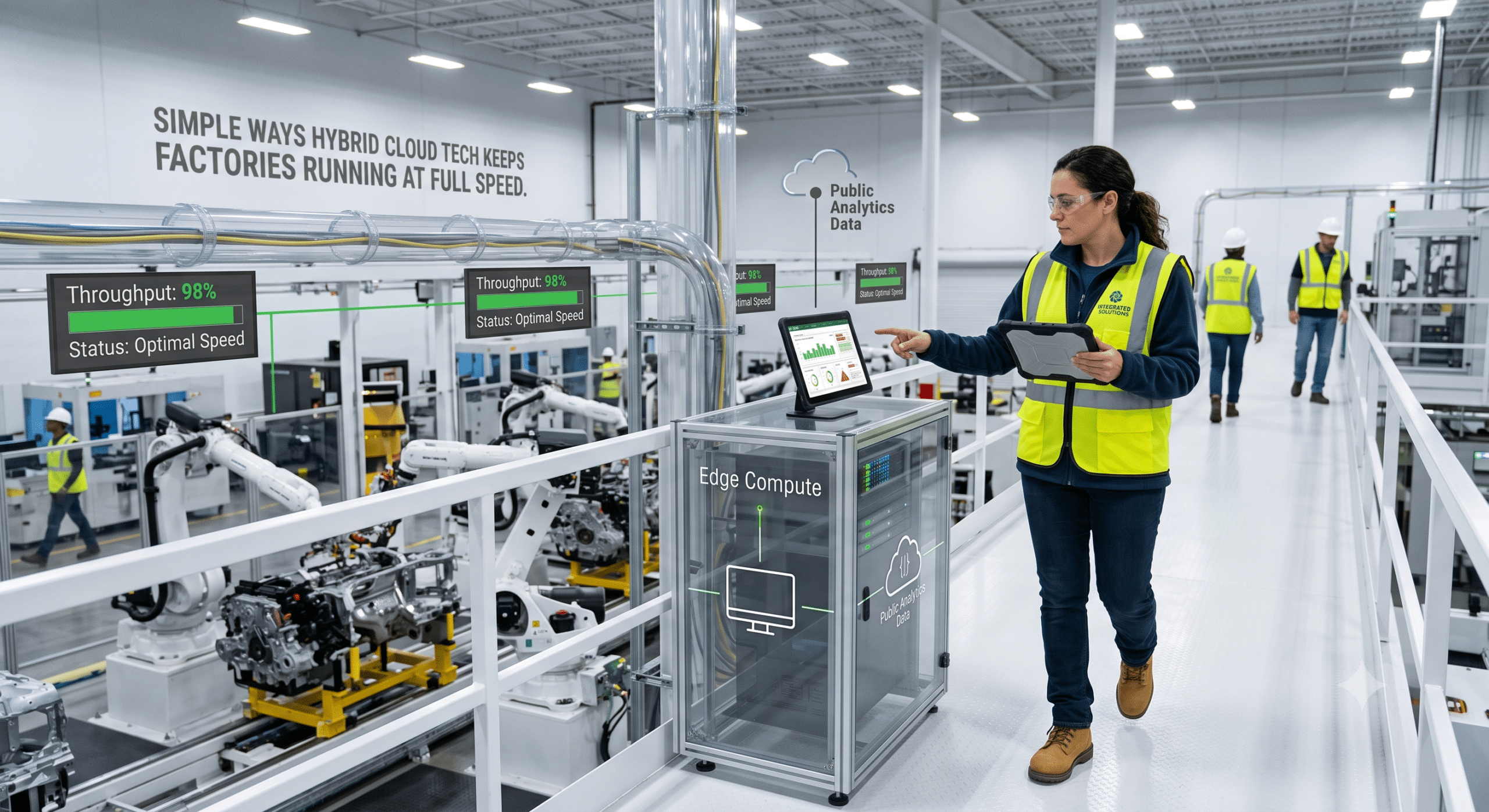
When you walk onto a modern factory floor, you see a complex dance. Heavy machinery and digital code move together. Today, keeping a business competitive means ensuring your software and your physical equipment work perfectly as a team. As a cloud solutions architect, my goal is simple: I use hybrid cloud infrastructure to help the factory floor pull out all the stops. Every line of code we write must help the business. Similarly, every server we set up must support our main operational goals. Specifically, we aim to make more products in less time. In addition, we want to keep production moving without delays. Finally, we must stop wasting expensive raw materials.
For a long time, companies tried to run everything in one of two ways. For example, they used local computers inside the building, or they used distant internet servers called the public cloud. Today, however, the smartest businesses mix both options. Naturally, we keep urgent tasks close to the machines. Meanwhile, we send heavy data analyzing tasks to the cloud. Consequently, this method gives us the best of both worlds. Let’s look at how this setup changes modern production.
The Link Between Software and the Factory Floor
In the past, tech teams and assembly line managers worked in separate worlds. Of course, that does not work anymore. Today, computer networks cannot slow down for even a second. If they do, a machine on the floor stops moving immediately. As a result, that delay costs you time and money.
Furthermore, data can get lost or corrupted on its way to a machine. When that happens, the machine might cut a piece of metal incorrectly. Alternatively, it might misapply a component. Ultimately, this mistake creates immediate trash. A hybrid cloud acts as the bridge between these two environments. For this reason, it places small, fast computer systems right next to the assembly lines to handle urgent tasks. Meanwhile, it uses the massive power of the public cloud to look at the big picture and plan ahead.
+-------------------------------------------------------------+
|                      THE PUBLIC CLOUD                       |
|  - Studies months of historical data to spot long-term trends|
|  - Handles massive computing tasks without slowing down     |
+-------------------------------------------------------------+
                              ^
                              | Fast, Secure Connection
                              v
+-------------------------------------------------------------+
|                     LOCAL EDGE COMPUTERS                    |
|  - Talks to the machines instantly with zero delay          |
|  - Keeps things running even if the main internet goes down |
+-------------------------------------------------------------+
1. Making More Products by Removing Digital Traffic Jams
High-speed machines process parts quickly. Therefore, they cannot send questions to a distant server three states away for every single part. That process slows the whole assembly line to a crawl. In short, you cannot build things quickly if your machines constantly wait for data to travel.
Fortunately, a hybrid cloud fixes this problem. It puts small, rugged computers right next to the machines. Consequently, these local units handle second-by-second choices instantly. The machines do not wait for data to cross the country. Because of this, they run at their absolute top physical speed all day long.
2. Speeding Up Production Times by Splitting the Work
Short production times require smart choices. Therefore, you must assign computer tasks to the place where they finish the fastest. Some tasks require an instant reaction. For example, an automated camera might check a part for defects. These tasks must stay on the local computers right next to the machine.
On the other hand, heavy tasks belong in the public cloud. For instance, you might look at a whole month of data to save energy. Splitting the work keeps the local computers from getting overwhelmed. Thus, they will not freeze up. As a result, the physical line moves smoothly without any hiccups.
                                 [ Raw Machine Data ]
                                          |
                   +----------------------+----------------------+
                   |                                             |
         (Needs an Instant Choice)                     (Needs Big Analysis)
                   |                                             |
                   v                                             v
     +---------------------------+                 +---------------------------+
     |   LOCAL EDGE COMPUTERS    |                 |     THE PUBLIC CLOUD      |
     |  - Instant camera checks  |                 |  - Looks at monthly trends|
     |  - Emergency stop buttons |                 |  - Builds smart models    |
     +---------------------------+                 +---------------------------+
                   |                                             |
                   +----------------------+----------------------+
                                          |
                                          v
                            [ A Faster Assembly Line ]
3. Cutting Down on Wasted Material with Smart Sensors
Wasting raw materials drains massive amounts of money. Sometimes a machine breaks down or drifts out of alignment. If managers do not notice the issue for three hours, disaster strikes. Specifically, every single part made during that time goes straight into the trash.
Thankfully, a hybrid cloud setup solves this issue. Local sensors listen to the machines constantly. In addition, they watch for tiny changes in heat or vibration. If a machine acts up, the local computer catches it instantly. Then, it tweaks the settings or stops the line immediately. Therefore, it acts before a worker makes a bad part. Meanwhile, the cloud saves the history of these issues. This data helps the system get smarter over time.
4. Building Fast Data Roads Between Environments
A working hybrid cloud requires good design. Therefore, engineers must build clean, wide data roads to connect your building to the public cloud. Architects use dedicated, high-speed lines. These lines act like a private highway for your business data. As a result, they bypass the traffic jams of the regular public internet.
We also compress the data into small packages before the system sends it. Most importantly, we set up clear traffic rules. For example, emergency signals from the machines always skip to the front of the line. This step ensures that critical safety warnings never wait behind routine paperwork.
5. Keeping Systems Safe Without Slowing Things Down
Protecting a company’s data is critical. However, security rules should never make it harder for employees to work. For this reason, we use a security strategy called “Zero Trust.” Under this rule, the system double-checks everyone. Specifically, it verifies every device and person trying to log in, without exception.
In addition, we build strong digital walls. These walls separate the factory floor computers from the regular office computers. Imagine an office worker opens a bad link in an email by accident. Because of our setup, the problem stays stuck in the office. Consequently, it cannot cross over to stop the physical production machinery.
+-----------------------------------------------------------------------+
|                         OFFICE SYSTEM ZONE                            |
|  - Office emails, accounting spreadsheets, and normal web browsing    |
+-----------------------------------------------------------------------+
                                   |
                  ===================================  [ STRONG DIGITAL WALL ]
                  | Continuous Identity Checkpoints |  [ ZERO-TRUST SECURITY ]
                  ===================================
                                   |
+-----------------------------------------------------------------------+
|                      FACTORY FLOOR ZONE                       |
|  - Real-time machine sensors and local control computers              |
+-----------------------------------------------------------------------+
6. Making Software Easy to Move Using Containers
Getting locked into a single software vendor is a big trap. If your software only works on one specific cloud, you face high costs. Therefore, you must pay whatever price they want. To prevent this, we use a technology called “containers.”
Think of a software container just like a standard metal shipping box. The box always keeps the same shape. Because of this, it fits perfectly on a ship, a train, or a truck. Similarly, we put our software inside these digital containers. Now, we can run the exact same program anywhere. For example, it works on a small local computer or inside a massive cloud data center. Consequently, you do not have to change a single line of code.
7. Saving Money by Adjusting Resources Automatically
Running heavy computer systems gets expensive quickly. Therefore, you must watch costs carefully. A smart enterprise system uses automation to scale resources up or down. Specifically, the system adapts based on how busy the business is. During a massive production rush, the system rents extra cloud space. As a result, this extra space handles the data surge.
Later, the factory closes for the weekend or breaks for maintenance. When this happens, the system turns those extra cloud features off. Consequently, you avoid paying for idle computers. Furthermore, we set up rules that automatically move old records. They go to cheap digital storage closets. This practice keeps your monthly bills low.
8. Staying Online Even When the Internet Fails
Construction crews outside might cut the local phone or internet lines. However, a factory cannot afford to stop working during these incidents. Therefore, engineers build the hybrid cloud setup specifically to survive these moments. The local computers inside the building operate entirely self-sufficiently.
For instance, the main internet connection might drop completely. Even so, the factory floor keeps running normally. Instead of stopping, it saves all its data onto local hard drives. Once the internet comes back online, the system acts immediately. It automatically sends the saved updates up to the cloud. Thus, you do not lose a single file or mess up the records.
9. Using Automated Checks for Long-Term Safety
Businesses grow and open new locations. When this happens, managing all the different computers by hand becomes impossible. In fact, a single human mistake in a setting can cause a major shutdown. To fix this, we write down our computer setups as code files.
An automated control system constantly checks every computer in the company. Specifically, it tests them against these master files. Sometimes a setting changes by accident. Fortunately, the system catches the error and fixes it automatically. Ultimately, this automation makes sure every location stays secure, identical, and running smoothly.
+-----------------------------------------------------------------------+
|                      AUTOMATED CONTROL SYSTEM                         |
+-----------------------------------------------------------------------+
         |                                                   |
         | (Sends Out Perfect Setups)        (Watches for Changes Constantly)
         v                                                   v
+-------------------------------+                     +-----------------+
|      MASTER SETUP FILES       |                     | AUTOMATIC FIXER |
|  - Identical security rules   |                     | - Finds errors  |
|  - Matching network settings  |                     | - Fixes them    |
+-------------------------------+                     +-----------------+
Frequently Asked Questions
How does this technology stop materials from being wasted?
It stops waste by catching machine mistakes immediately. For example, sensors on the machines check things like heat and balance every millisecond. If a machine starts drifting, the local computer corrects it or pauses the line instantly. Therefore, it acts before a worker can cut a bad part.
Why don’t we just put everything out on the internet cloud?
If you put everything on the internet cloud, you depend entirely on your web connection. If the internet slows down, your machines slow down. Furthermore, if the internet drops, you must close your business for the day. Therefore, keeping local computers on-site ensures your floor stays safe and fast.
What is a software container?
A software container is a package. It holds a program and everything the program needs to run. Because it is self-contained, you can move it easily between different computers and cloud systems. Consequently, it will always work exactly the same way without breaking.
Will these security rules make it harder for employees to work?
No, because the security works quietly in the background. We separate the office computers from the factory machines. This separation protects the business from cyber threats. However, it does not add confusing steps for the people working hard on the production floor.
References for Further Reading
-
To learn the basic building blocks of mixing local systems with the cloud, read the official guide on Best practices for building a hybrid cloud architecture with AWS services.
-
For a clear look at how to manage these systems easily without tech headaches, check out the article on Hybrid Cloud Best Practices – Manage your Environment with Ease.