

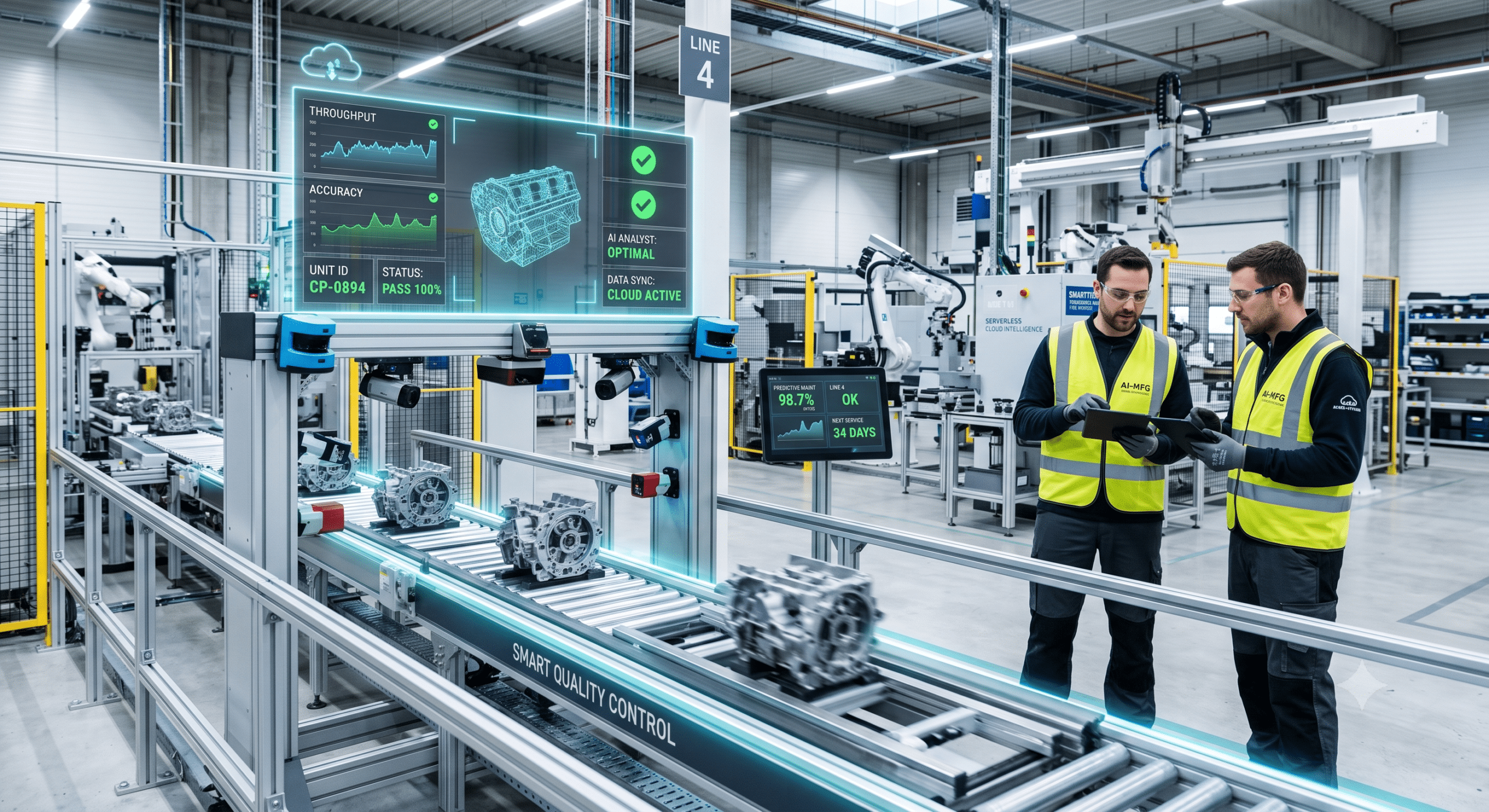
Modern manufacturing facilities are rapidly adopting serverless computing to keep pace with unpredictable global supply chains, instant customization demands, and a highly competitive talent market. If you look closely at what slows down a modern factory floor, the biggest bottleneck often is not the physical machinery, but rather the old, clunky enterprise software systems running poorly behind the scenes. Fortunately, transitioning to this advanced cloud framework allows industrial organizations to completely bypass traditional IT infrastructure bottlenecks. By eliminating infrastructure management, companies can focus directly on what matters most: maximizing operational throughput, shortening production cycle times, and driving down material scrap rates.
Consequently, when legacy software is slow or crashes, the whole assembly line stalls immediately. To fix this, forward-thinking factories are switching to a new cloud setup built entirely around serverless computing.
However, you should not let the name fool you. There are still physical servers out there in giant data centers, but your company does not have to buy, manage, patch, or worry about them. Instead, the cloud provider handles all the heavy IT lifting automatically. As a result, this allows your engineers, developers, and floor managers to focus entirely on making the assembly line run as smoothly as possible.
Therefore, when you look at this new cloud model through the lens of basic factory metrics, adopting serverless computing acts as a major game-changer. For example, it helps get more products out the door while it simultaneously speeds up production times. In addition, it ensures you throw away less ruined material. Let us look at the 12 basic ways this modern technology improves daily life on the factory floor.
1. Zero Server Hassle Means Engineers Focus on the Line
In a traditional factory, launch delays happen quite often. For instance, when a quality control engineer wants to launch a new software tool to track a conveyor belt, they face endless roadblocks. Specifically, they have to order local hardware, wait for operating system updates, and spend weeks configuring settings. Ultimately, this massive delay slows down the entire facility.
Fortunately, modern serverless computing completely removes this roadblock. The underlying technology remains invisible to your team, and because of this, software developers simply write the code and turn it on instantly.
Consequently, your smart engineers can stop spending hours fixing computer bugs or running server maintenance. Instead, they can spend all their time on the factory floor. For example, they can focus on fixing mechanical bottlenecks and improving physical setups, which naturally helps the business build more products every single day.
2. Real-Time Triggers Cut Down Production Delays
Waiting around for data is a huge time-waster. In older systems, computers process information in batches, meaning they might check machine temperatures only once every hour. Therefore, if a furnace gets too hot five minutes after a check, it will keep cooking and ruining materials for a long time. As a result, operators will not notice the issue until the next cycle.
In contrast, an architecture running serverless computing avoids this issue completely. This is because it works on immediate, real-time actions called triggers. The second a machine sensor notices a strange temperature spike, it instantly fires off a small piece of cloud code to handle that exact issue right away.
Thus, this setup cuts down your total production cycle time significantly. You no longer have to wait around for a slow central computer system to catch up. Instead, the cloud reacts the exact millisecond something changes, keeping production moving without costly interruptions.
3. Pay-As-You-Go Billing Lowers Your Overhead Costs
Standard computer servers are highly expensive because you must buy enough capacity to handle your absolute busiest days. This means that when the factory floor shuts down for weekend maintenance, holiday breaks, or routine cleaning, those expensive computers sit idle. Consequently, they continue to drain your corporate budget without delivering value.
On the other hand, choosing serverless computing changes the financial rules completely. This is because it charges you only for the exact milliseconds the code is actively running. For example, if a production line pauses for an hour to swap out a mechanical part, the cloud services for that line instantly drop to zero, meaning this pause costs you nothing.
Therefore, this clear financial structure helps management see the direct relationship between technology spending and physical output. You no longer look at software as an unpredictable corporate expense. Instead, it becomes a flexible cost that moves in perfect sync with your production volume.
4. Automatic Scaling Handles Hidden Surges with Ease
Factory data goes through massive ups and downs, and this volatility happens often when you switch from small, custom runs to high-volume manufacturing. For instance, thousands of sensors might start broadcasting data at the exact same moment. When this happens, standard servers can easily overload and crash, leaving operators completely blind.
However, platforms that leverage serverless computing solve this problem through automated engineering. Specifically, the system scales up instantly and automatically. If your data traffic suddenly jumps from ten messages a second to ten thousand, the cloud automatically adds digital power to match the exact amount needed to handle the load.
[Sensors and Cameras] ──(Heavy Influx of Data)──> [Serverless System]
                                                          │
                                            ┌─────────────┴─────────────┐
                                            ▼                           ▼
                                  [Digital Power Automatically Expands]
                                                          │
                                                          ▼
                                            [Clean, Uninterrupted Data Logs]
Indeed, this absolute flexibility ensures your monitoring apps never lag or freeze. The digital systems continue to run smoothly, and because of this, your crew can keep the physical assembly line moving at maximum speed without worrying about computer crashes.
5. Separated Software Modules Prevent Catastrophic Line Crashes
Old-fashioned software relies on single-block designs. In these systems, one tiny error in a basic feature can cause the whole computer system to crash. For example, a glitch in a shipping label creator might halt everything. If this happens while a machine mixes a precise batch of expensive materials, operators lose all visibility and must discard the entire batch for safety reasons.
To prevent this total loss, modern applications use serverless computing to break software down into tiny modules. Furthermore, these modules remain completely separate from one another. Therefore, if the shipping module develops a glitch and stops working, the critical quality inspection gate keeps running without a single hiccup.
Old Monolithic Software:
┌────────────────────────────────────────────────────────┐
│ Quality Gate  +  Shipping Labels  +  Inventory Levels  │ ──> (One small bug crashes the whole factory)
└────────────────────────────────────────────────────────┘

Modern Serverless Software:
┌──────────────────────┐  ┌──────────────────────┐  ┌──────────────────────┐
│  Isolated Module 1   │  │  Isolated Module 2   │  │  Isolated Module 3   │ ──> (A bug in shipping has zero
│    (Quality Gate)    │  │  (Shipping Labels)   │  │  (Inventory Levels)  │      effect on your quality gate)
└──────────────────────┘  └──────────────────────┘  └──────────────────────┘
Consequently, this smart separation protects your materials and lowers your scrap rate. Your tech team can confidently update and improve individual tools. In addition, they can deploy updates without any risk of accidentally shutting down the entire plant.
6. Lightweight Coding Speeds Up Daily Station Tasks
To maintain high speeds on a fast line, code execution inside a serverless computing platform uses a highly temporary design. Specifically, it does not hog memory or store old history inside the active code. Instead, it pulls the exact information it needs from secure external databases only when called upon by the operator.
Because the code travels light, it starts up in an instant. Therefore, for the workers on the line, this means zero waiting around for apps or screens to load.
For example, when an operator scans a part barcode at their station, the system pulls up the assembly instructions immediately. Shaving just two seconds off every scan across dozens of stations adds up quickly, resulting in a massive drop in total assembly time by the end of the shift.
7. Built-In Reliability Keeps the Lights On
Having a single computer server in the back room of a factory is a major risk. For instance, a localized power outage, a blown fuse, or a broken cooling fan can instantly blind your entire team. Consequently, this stops production completely and costs thousands of dollars per minute.
Fortunately, modern serverless computing setups remove this risk through built-in redundancy. The platform features automatic backup systems directly within the cloud network. In addition, the cloud providers automatically mirror your software across multiple, physically separate data locations across the country.
Thus, if one data center loses power or goes offline, your factory data undergoes instant rerouting to an active location without any human intervention. Ultimately, this reliable design keeps your business running smoothly through unexpected utility failures.
8. Smart Cameras Spot Defective Parts Instantly
Depending entirely on human eyes to spot manufacturing defects is risky. This is because even the most dedicated employees get tired during a long shift. Because of fatigue, it is easy to miss a microscopic scratch that could ruin a finished product later down the line.
Alternatively, you can connect your industrial serverless computing network to high-resolution cameras on the line to create an automated inspection system. As items move down the conveyor belt, cameras snap photos. Next, these photos trigger cloud functions that instantly check the measurements against exact design blueprints.
[Line Cameras] ──> [Trigger Cloud Check] ──> [Instant Visual Analysis]
                                                          │
                                            ┌─────────────┴─────────────┐
                                     Pass   ▼                    Fail   ▼
                              [Keep Moving on Line]     [Automatic Reject Arm]
                                                        (Zero Waste Downstream)
Because these digital checks happen in the blink of an eye, bad parts are tossed out the moment they fail inspection. Consequently, this keeps you from wasting time, labor, and additional materials on a broken piece, driving your waste metrics way down.
9. Smart Maintenance Fixes Tools Before They Break
Unexpected machinery breakdowns destroy a factory’s daily output. Furthermore, they cause massive schedule delays and disrupt delivery timelines. Relying on basic calendar schedules means you face two distinct problems: you are either replacing perfectly good parts too early, or waiting too long and dealing with a broken line.
In contrast, a cloud system running serverless computing helps you get ahead of repairs by constantly listening to sensor data. Specifically, it monitors the high-frequency information coming off your heavy machinery. For example, when an internal part begins to wear out, it creates a subtle vibration change that triggers a quick cloud alert automatically.
Therefore, your team does not have to wait for the machine to break down mid-shift. Instead, the system alerts the maintenance team, orders the replacement part, and schedules the repair during a natural break. As a result, this keeps your machines healthy and running without unexpected interruptions.
10. Faster Software Updates Shorten Setup Times for New Products
Whenever a factory introduces a brand-new product line, engineers must adapt quickly. For example, they have to rewrite code, update tracking tools, and change compliance settings. If your programming team has to spend weeks setting up test databases and networks, your physical assembly line sits empty and unprofitable.
Fortunately, modern serverless computing speeds up this process by removing almost all the technical setup work. Developers can ignore server provisioning entirely. Instead, they focus all their attention on writing the new rules for the new product.
Consequently, they can test and deploy software updates in minutes instead of weeks. This speed makes it easy to switch production lines over to new models quickly, allowing the factory floor to stay highly efficient during product transitions.
11. Automated Security Keeps Production Recipes Safe
As factory equipment becomes more connected to the internet, cybersecurity becomes a major priority. For instance, a single breach could leak proprietary product designs, alter precise machine recipes, or erase compliance logs. Inevitably, these events result in massive recalls and wasted inventory.
However, software running on serverless computing systems provides excellent security because the digital environments are temporary. The moment a specific calculation finishes, the environment vanishes completely. As a result, this leaves hackers with no open doors or permanent files to attack.
Furthermore, compliance tracking is built right into the workflow. Every single step of the manufacturing process can trigger an automatic log. Because this log records worker IDs, tool measurements, and environmental conditions, it ensures perfect records without slowing down the line.
12. Tearing Down Data Walls Unlocks Global Factory Success
In many old-school businesses, helpful production data remains trapped inside individual factories. For example, a great lesson learned about reducing waste at a plant in Texas rarely makes it to a sister facility in Ohio. Consequently, this isolation causes identical mistakes to happen twice.
Fortunately, an integrated serverless computing infrastructure acts as a bridge. It brings data from all your global facilities together into one accessible cloud environment. Then, this clean, well-organized information can be analyzed to find hidden inefficiencies across the entire company.
Therefore, when managers have full visibility into global metrics, success becomes easy to copy. A clever code update that successfully cuts down waste on a machine in one city can be shared worldwide with a single click. Ultimately, this simple action boosts efficiency everywhere at once.
Performance Quick-Reference Chart
To see exactly how these technical cloud features improve your core manufacturing metrics, review this simple breakdown:
| Cloud Feature | Impact on Daily Output | Impact on Production Speed | Impact on Total Waste |
| Zero Server Hassle | High; saves engineering time so teams can fix physical line issues. | Low; mostly accelerates software deployment. | Indirect; gives you more time to build tracking tools. |
| Real-Time Triggers | Medium; keeps data moving instantly between different factory zones. | Critical; eliminates wait times and allows fast machine adjustments. | High; catches machinery errors before they ruin a whole batch. |
| Automatic Scaling | High; prevents digital systems from freezing up during busy shifts. | Low; keeps computer response times steady. | Medium; ensures quality control checks never miss a part. |
| Separated Modules | Medium; keeps simple software bugs from shutting down the main line. | Low; keeps computer tasks clean and organized. | Critical; ensures safety gates stay online even if other apps glitch. |
| Lightweight Coding | Low; focuses entirely on processing transactions quickly. | Critical; cuts out computer lag times for operators on the floor. | Low; alters system speed rather than material quality. |
| Built-In Reliability | Critical; keeps your software online so production never stops. | Medium; avoids slow computer reboots and system resets. | Indirect; maintains perfect visibility across your plant. |
Final Thoughts for Manufacturing Leaders
In conclusion, transitioning to serverless computing is not just an abstract project for the IT department. Instead, it is a smart business decision that directly improves the daily output of your workforce. By removing the headache of traditional server management, you give your engineering and operational teams true freedom. Consequently, they can focus entirely on what they do best: maximizing production, speeding up cycles, and cutting out waste. As technology continues to march forward, the manufacturers who build their systems on a flexible, cloud foundation will undoubtedly lead the industry in quality, speed, and profitability.
Frequently Asked Questions
What does “serverless” mean if physical servers still exist?
Serverless simply means your business does not have to deal with the servers. Instead, a cloud provider handles all the physical hardware, security updates, and infrastructure maintenance in the background. Therefore, your team just uses the system, allowing them to focus entirely on improving factory floor operations.
How does a serverless cloud setup help reduce material waste?
Because the cloud responds instantly to real-time events, your quality control systems can inspect parts the moment they move down the line. Consequently, if a machine drifts out of alignment, the cloud software flags the issue instantly and can pause the line, preventing the system from ruining an entire batch of raw materials.
Will relying on a cloud setup introduce lag on a fast assembly line?
To keep speeds lightning-fast, modern setups use a hybrid design that processes data right on the factory floor using local edge devices while sending larger analytical data up to the main cloud. Thus, this gives you the best of both worlds: instant local response times and massive cloud storage.
How does this cloud transition change the skills my current workforce needs?
It reduces the need for deep, highly specialized IT infrastructure maintenance teams inside your plant. Instead of hiring people to patch servers, you can focus on upskilling your current team to analyze operational data and optimize machinery, turning your technology staff into direct production partners.
References for Further Reading
-
For an in-depth exploration of the software design patterns that power modern cloud services, read the detailed walkthrough on Serverless Architecture: The Beginner’s Guide.