

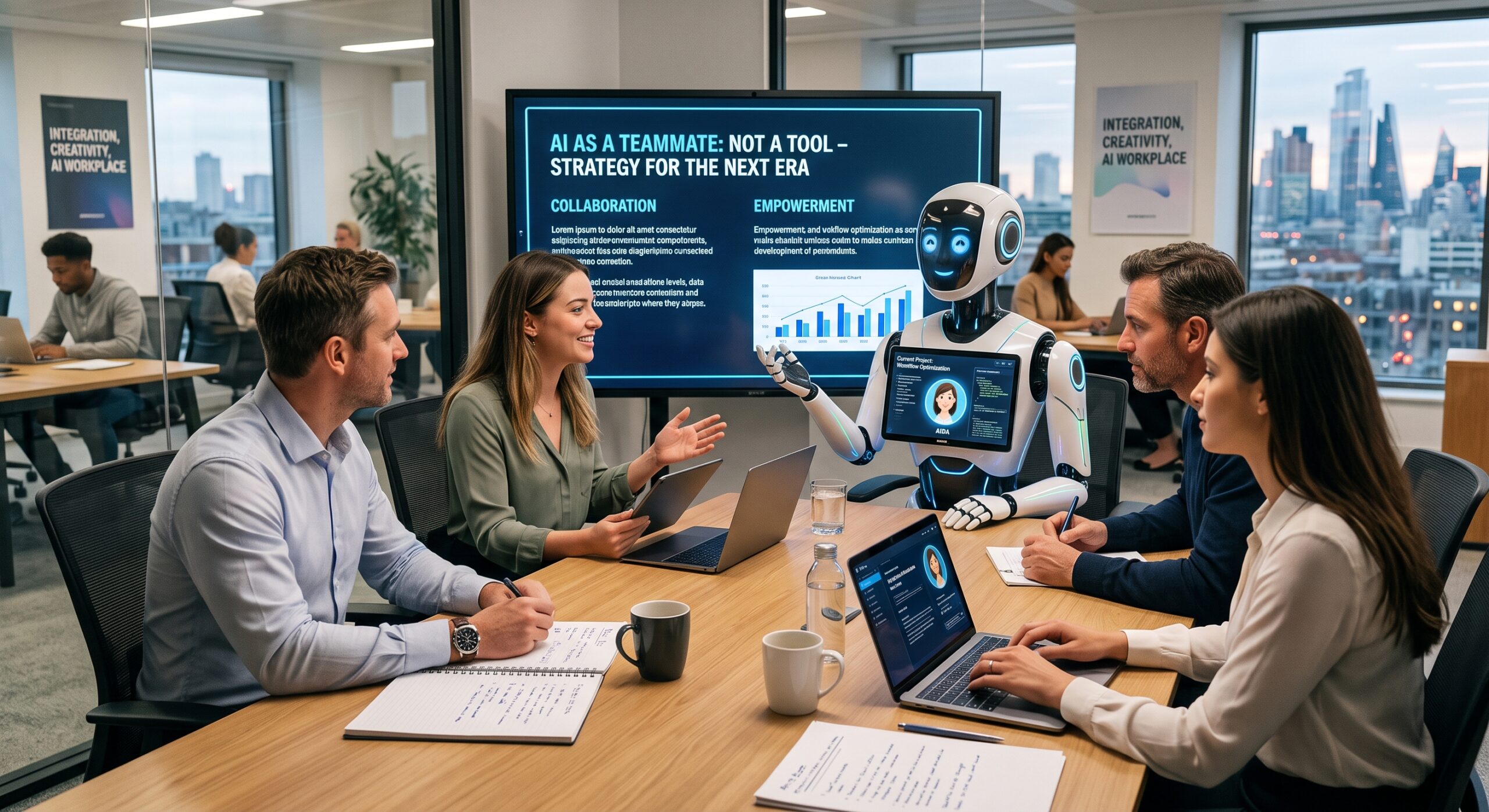
The most important question about workplace automation is no longer whether artificial intelligence will change how work gets done. Indeed, leaders have already made that decision. Instead, the more important question is whether organizations will treat AI as another software tool to deploy—or as a new kind of teammate that teams must integrate into the way people collaborate, make decisions, and create value.
Ultimately, this distinction matters.
While a tool waits for instructions, a teammate actively participates in a workflow. Similarly, whereas a tool merely helps someone complete a task, a teammate can take responsibility for a defined part of an outcome, communicate progress, identify obstacles, and return work for human review.
However, that does not mean teams should treat AI as human. After all, it does not possess judgment, accountability, or lived experience in the way employees do. Nevertheless, organizations that continue to approach AI as a faster version of traditional software may miss the deeper transformation taking place. Consequently, smarter applications alone will not define the future of work. Rather, hybrid teams—in which human employees and AI systems contribute different capabilities toward shared goals—will shape that future.
Therefore, this shift will require more than technology investment. Specifically, it will require leaders to rethink jobs, management, culture, performance measurement, and trust.
From Tools to Teammates
For decades, workplace technology followed a familiar pattern. First, organizations purchased systems; next, leaders trained employees to use them; and finally, managers measured adoption. Throughout this process, technology remained separate from the operating model. As a result, software forced employees to adapt their behavior around it.
Today, generative AI and AI agents fundamentally challenge that legacy model.
For example, an AI system can summarize a meeting, analyze a contract, research a market, draft a proposal, identify a pattern in customer data, or coordinate several steps in a business process. Furthermore, more advanced systems can plan and execute work across applications, subject to permissions and review. Consequently, the employee no longer simply operates software. Instead, the employee directs work that an intelligent system may partly perform.
Microsoft’s 2026 Work Trend Index describes this change as an expansion of human agency. Specifically, as AI and agents take on more execution, people gain more room to set direction, make decisions, and own outcomes. Their research included 20,000 AI-using workers across 10 countries and found that 66% said AI enabled them to spend more time on high-value work.
However, while that promise is significant, technology does not guarantee success automatically. Giving employees access to AI does not, by itself, create better work. Rather, real value emerges when organizations clarify what AI should do, what people should do, and how both sides will work together.
Ultimately, this is the central leadership challenge: leaders must treat workplace automation as a design discipline, not merely a procurement category.
The New Division of Work
In the next era, the most effective organizations will divide work according to strengths rather than tradition.
On one hand, AI handles activities involving speed, scale, pattern recognition, and consistent execution exceptionally well. For instance, it can examine large volumes of information, detect anomalies, generate alternatives, and perform repetitive actions without fatigue. On the other hand, people remain essential for context, empathy, ethical reasoning, relationship-building, creativity, physical judgment, and accountability.
Therefore, the practical question is not, “Which jobs can AI replace?” That question is far too blunt to guide a responsible transformation. Instead, leaders should ask:
- Which outcomes are we trying to improve?
- Which parts of the workflow require speed and scale?
- Where does human judgment create the greatest value?
- What decisions should we never delegate?
- How will employees review, correct, and improve AI-generated work?
Consider, for example, a customer service team. An AI teammate might classify incoming requests, retrieve relevant account information, suggest a response, and identify cases that require escalation. Meanwhile, a human service professional still needs to interpret emotion, resolve ambiguity, make exceptions, and protect the customer relationship.
As a result, the outcome does not simply mean fewer tasks for people. Instead, it can lead to better work for people—provided the organization does not use automation solely to increase workload expectations.
Indeed, that final condition is crucial. If AI completes routine work but leaders use the saved time to demand more routine work, the employee experience will not improve. In that scenario, the organization achieves acceleration without progress.
Eight Principles for Responsible Automation
Organizations do not need a perfect long-term blueprint before beginning. However, they do need a clear set of principles. The following eight guidelines can steer workplace automation while preserving human capability and trust.
1. Start with Outcomes, Not Tools
The strongest automation programs begin with a specific business or human problem. Consequently, leaders do not start them with a vendor demonstration or a list of available features. For instance, a department might aim to reduce customer response times, improve forecasting accuracy, shorten onboarding, or give employees more time for strategic work. Thus, the desired outcome should determine where team members introduce AI and how leaders measure success.
2. Automate Work, Not Accountability
While AI can execute a process, a person or group must retain accountability for its consequences. Therefore, every automated workflow needs a clear owner who understands the system’s purpose, limitations, and escalation rules. Ultimately, leadership cannot let accountability disappear into a platform.
3. Give AI a Defined Role
Employees work better with colleagues when they understand responsibilities clearly, and the same holds true for AI systems. For example, an AI teammate might serve as a researcher, first-draft writer, quality checker, workflow coordinator, or data analyst. Consequently, defining the role helps employees understand what they can expect the system to do and where its involvement ends.
4. Design Human Handoffs Deliberately
Teams must never treat human review as an afterthought. Therefore, leaders must define when AI can act independently, when it must ask for approval, and when a human must take over completely. In particular, high-risk decisions involving employment, health, safety, credit, legal exposure, or customer harm require especially strong review processes.
5. Protect the Ability to Think
Automation can create a dangerous form of cognitive dependence. If employees stop practicing analysis, writing, judgment, or problem-solving, the organization may gain speed in the short term but suffer significant weakness in the long term.
Indeed, Microsoft found that 86% of surveyed AI users treat AI output as a starting point rather than a final answer. Moreover, advanced users intentionally performed some work without AI to keep their skills sharp. Thus, leaders should not aim for maximum AI use; rather, they should pursue stronger human performance supported by appropriate AI tools.
6. Measure Value Beyond Productivity
Although productivity is important, it cannot stand as the sole metric. Therefore, organizations should also measure quality, customer outcomes, employee learning, decision accuracy, innovation, and resilience. For instance, a system that reduces handling time while increasing errors creates no real value. Similarly, a system that drafts more content while weakening brand trust fails. As a result, metrics must reflect the full outcome.
7. Make Experimentation Safe and Visible
In practice, employees discover valuable uses of AI long before formal strategy catches up. Thus, leaders should create safe channels for experimentation while clearly stating which data, systems, and decisions remain off-limits.
In this regard, managers play a particularly important role. Microsoft’s research found that when managers modeled AI use, employees reported a 17-point increase in perceived AI value, a 22-point increase in critical thinking about AI use, and a 30-point increase in trust in agentic AI. Simply put, people need permission to learn, not pressure to pretend they already know everything.
8. Build a Learning System
Every AI-assisted workflow generates valuable information about what works, what fails, and where tasks still require human judgment. Consequently, organizations should capture those lessons and turn them into better processes, training, and governance. This is how workplace automation compounds over time: the organization does not merely automate a task once; instead, it learns from every cycle and continually improves the relationship between people and AI.
The Manager’s Role Will Change
Traditionally, managers coordinated people, assigned tasks, reviewed performance, and resolved obstacles. In an AI-enabled workplace, those core responsibilities remain—however, managers must shift their day-to-day focus significantly.
Specifically, a manager will increasingly coordinate a blended team of employees and AI agents. Consequently, this requires a deep understanding of capacity, dependencies, quality standards, and risk. Furthermore, the manager must frequently decide whether to delegate a task to an AI system, assign it to an employee, or handle it jointly.
Therefore, this shift does not reduce the importance of management; rather, it raises the overall standard.
For example, managers will need to:
- Explain the overarching purpose behind automation.
- Establish clear expectations for responsible AI use.
- Review the quality of human-AI collaboration.
- Identify essential skills that employees must continue developing.
- Ensure that automation creates real capacity rather than hidden overload.
- Recognize employees who improve workflows, not only those who complete more tasks.
Ultimately, the best managers will become designers of work. As a result, they will spend less time monitoring activity and more time shaping conditions for good judgment, continuous learning, and effective collaboration.
What Happens to Jobs?
The honest answer is that jobs will change unevenly.
On one hand, some roles will lose substantial amounts of routine work. On the other hand, other roles will expand because AI makes previously impractical services possible. Additionally, brand-new responsibilities will emerge around workflow design, AI quality assurance, data stewardship, security, governance, and human experience.
Furthermore, McKinsey’s 2025 State of AI research found that while 88% of respondents said their organizations regularly used AI in at least one business function, only about one-third reported that their organizations had begun scaling AI programs enterprise-wide. Significantly, the research also revealed that redesigning workflows strongly correlated with organizations achieving greater overall value from AI.
This insight tells us two things:
- First, broad adoption is already occurring.
- Second, meaningful transformation remains difficult.
Consequently, the organizations that handle workforce transitions well will not make vague promises that every job will remain unchanged. Instead, they will provide transparency about which tasks they are redesigning, invest heavily in reskilling, and create tangible opportunities for employees to move toward higher-value work.
Thus, workforce planning must become far more dynamic. Instead of reviewing roles once a year, leaders may need to examine how tasks, skills, and responsibilities evolve every quarter.
Trust is an Operating Requirement
Marketers cannot simply add trust through a campaign after IT deploys an AI system. Rather, organizations must build trust directly into the operating model from day one.
For instance, employees need to know how teams use AI, what information the system can access, how managers monitor its performance, and who assumes responsibility when something goes wrong. Similarly, customers need confidence that automated interactions will not compromise privacy, fairness, or service quality.
Consequently, building trust into workplace automation requires leaders to establish clear standards for:
- Data access and retention.
- Human review protocols.
- Bias testing and mitigation.
- Security and system permissions.
- Audit trails.
- Employee monitoring policies.
- Disclosure during human-AI interactions.
- Appeals and correction processes.
Moreover, organizations should assign AI agents identities, permissions, and lifecycle controls similar to other enterprise entities. For example, an agent that accesses sensitive systems or takes action on behalf of an employee should never operate as an invisible background process.
Ultimately, as a system receives more autonomy, visibility becomes far more critical.
The Next Era Belongs to Redesigned Organizations
The organization with the largest collection of AI tools will not win the future of workplace automation. Rather, the organization that learns how to combine technology with human judgment better than its competitors will win.
Consequently, that requires a fundamental shift in mindset.
AI is not simply a mechanism for reducing the human labor required to perform existing processes. Instead, it offers an opportunity to reconsider which processes should exist in the first place, how teams should make decisions, and what employees can accomplish when fully empowered.
Therefore, a thoughtful executive should ask five key questions:
- Where can AI expand human capability rather than merely reduce cost?
- Which workflows should we redesign from the ground up?
- What skills must employees build, practice, and protect?
- What governance do we require before granting AI greater autonomy?
- How will we know whether the transformation improves work for people and outcomes for the business?
Ultimately, leaders should not interpret the phrase “AI as a teammate” as an invitation to humanize technology. Rather, it serves as a reminder that collaboration requires structure. After all, teammates have roles, expectations, boundaries, feedback loops, and shared goals.
Organizations that provide those conditions will use AI responsibly and effectively. Conversely, organizations that treat AI merely as a collection of disconnected tools may achieve isolated efficiency while completely missing the larger opportunity.
In the end, human-versus-machine competition will not define the next era of work. Instead, the quality of the partnership between them will define it entirely.
Frequently Asked Questions
What does workplace automation mean?
Workplace automation refers to using software, artificial intelligence, robotics, or connected systems to perform tasks and coordinate business processes with limited human intervention. Consequently, it can include simple repetitive actions (such as data entry) as well as complex, multi-step workflows that AI agents manage.
How is AI as a teammate different from AI as a tool?
A tool usually supports a specific task only when a person activates it. In contrast, an AI teammate can participate in a broader workflow by planning steps, producing work, communicating status, and returning decisions or outputs for human review. Ultimately, the distinction centers on the role AI plays in the operating model, rather than treating AI as an actual person.
Will AI eliminate jobs?
While AI will eliminate some routine tasks and may reduce demand for certain roles, it will also change existing jobs and create new responsibilities. Therefore, the impact will vary significantly by industry, occupation, and organizational strategy. As a result, responsible employers should focus on transparency, reskilling, redeployment, and fair transition practices.
What should companies automate first?
Companies should typically begin with workflows that are repetitive, measurable, relatively low risk, and frustrating for employees. For example, good starting points include information retrieval, scheduling, document classification, routine reporting, and first-draft preparation. However, teams should approach high-impact or sensitive decisions much more cautiously.
What skills will employees need?
Employees will increasingly need critical thinking, communication, domain expertise, judgment, adaptability, and the ability to define clear outcomes. Additionally, they must understand how to evaluate AI-generated work, identify errors, protect sensitive information, and collaborate effectively across human and digital workforces.
How can leaders build trust in workplace automation?
Leaders can build trust by clearly explaining the purpose of automation, involving employees in workflow design, setting clear usage policies, and maintaining meaningful human oversight. Furthermore, trust grows when employees see that automation improves their work rather than simply intensifying performance demands.
How should managers evaluate AI performance?
Managers should evaluate AI performance against accuracy, quality, reliability, safety, fairness, cost, customer outcomes, and employee experience. Moreover, organizations should monitor performance continuously because an AI system may behave differently as underlying data, processes, or business conditions change over time.
What is the biggest mistake organizations make?
The biggest mistake involves treating AI adoption as merely a software rollout. Installing a system without redesigning roles, processes, incentives, and governance often produces very limited value. Conversely, workplace automation succeeds when leaders tightly connect it to a clear strategy for how work should get done.
References
- Microsoft Work Trend Index 2026: Agents, Human Agency, and the Opportunity for Every Organization
- McKinsey & Company: What Are AI Agents, and What Can They Do for Enterprise Workflows?
- Google Cloud Blog: 5 Insights to Build Your Agentic AI Advantage in 2026
- Cisco Newsroom: How AI Will Transform the Workplace in 2026 (Connected Intelligence)