

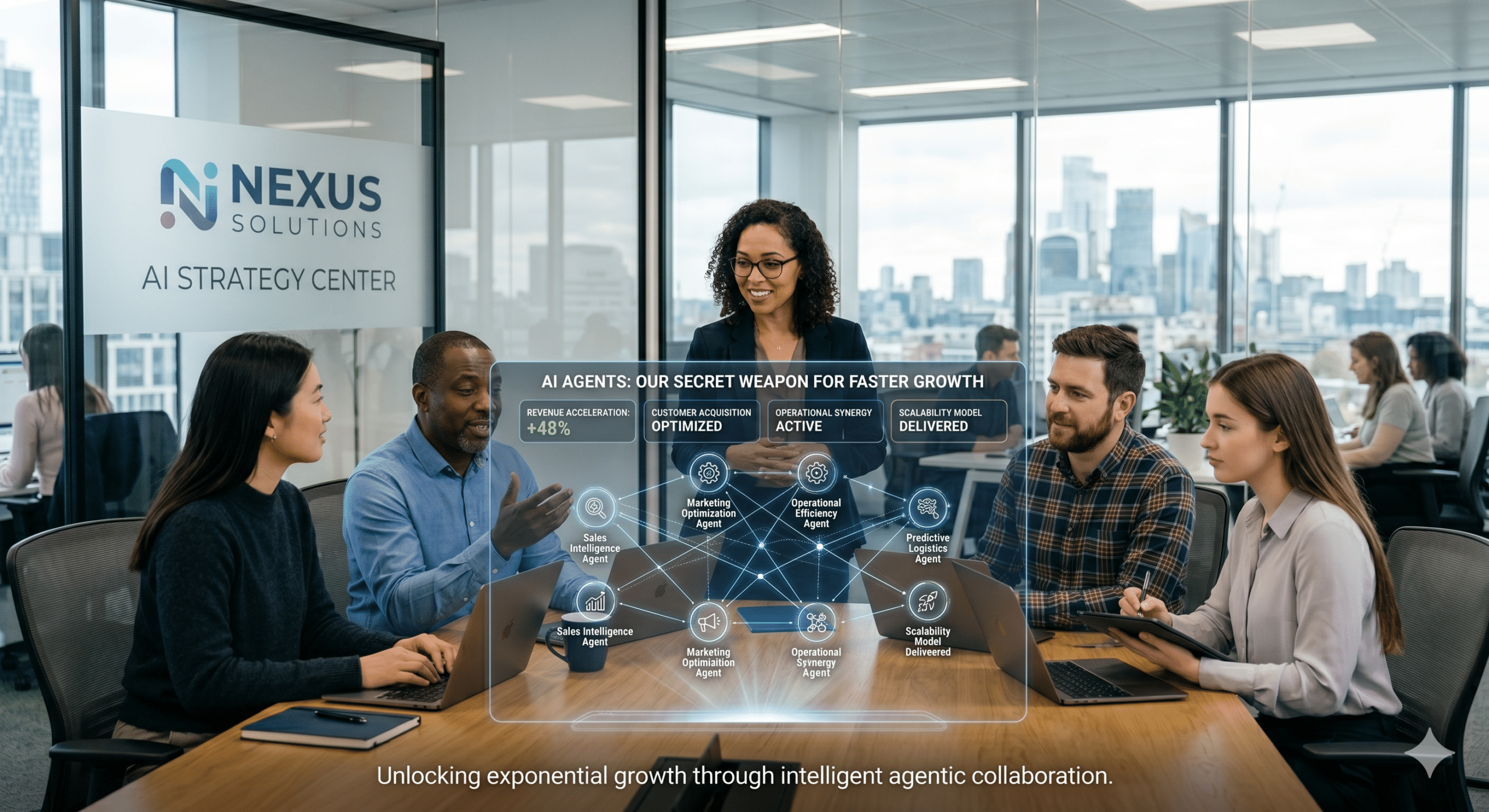
Artificial intelligence is evolving at a remarkable pace. Just a few years ago, most businesses viewed AI as a tool for generating content, answering questions, or improving productivity. Today, however, organizations are entering a completely different phase of adoption. Instead of simply providing information, modern AI systems are beginning to take action, complete tasks, and make decisions within defined boundaries. This shift is being driven by one of the most exciting developments in technology today: AI agents.
As an AI engineer, I see this transformation happening across industries of every size. Companies are no longer asking whether artificial intelligence can help their business. Instead, they are asking how quickly they can deploy intelligent systems that automate work, improve customer experiences, and create measurable business value. Those conversations are fueling a new wave of investment in agentic AI and autonomous business automation.
The organizations that embrace this technology strategically are positioning themselves to operate more efficiently, scale more effectively, and compete in ways that were difficult to imagine only a few years ago.
What Are AI Agents?
The term “AI agents” is often used alongside phrases like agentic AI, autonomous AI, and intelligent automation. Although these terms are related, the simplest way to understand AI agents is this:
An AI agent is software that can perceive information, reason about a goal, take action, evaluate outcomes, and continue working toward an objective without needing constant human instructions. (Ecosire)
Unlike traditional chatbots that wait for users to ask questions, AI agents can proactively complete tasks.
Imagine telling an AI:
“Find qualified leads for our business, send personalized outreach emails, schedule meetings with interested prospects, and update our CRM.”
A chatbot would likely provide suggestions.
An AI agent would attempt to perform the entire process.
That difference is what makes this technology so transformative.
The Evolution From Chatbots to Autonomous Workers
Many organizations mistakenly assume intelligent software agents are simply advanced chatbots.
In reality, they represent an entirely new category of business technology.
The first wave of AI focused on information retrieval. Users asked questions and received answers.
The second wave introduced generative AI. Users could create content, code, images, and reports with simple prompts.
The third wave is now emerging through AI agents. Instead of generating information alone, these systems execute actions and complete objectives. (Axonix Labs)
Think about the difference between an employee who gives advice and an employee who actually completes the work.
That distinction explains why businesses worldwide are investing heavily in agentic AI solutions.
Recent industry developments from major technology companies show that AI agents are rapidly becoming a strategic priority for enterprise software providers and business leaders alike. (Reuters)
Why Businesses Are Investing in Autonomous AI Systems
Several factors are driving this surge in adoption.
First, labor costs continue to rise globally. Organizations are searching for ways to increase productivity without endlessly expanding headcount.
Second, customers now expect immediate responses. Waiting several hours or even a full day for support feels outdated in many industries.
Third, businesses are overwhelmed with repetitive administrative tasks that consume valuable employee time.
Finally, modern AI models have become capable enough to perform increasingly sophisticated work across multiple systems and applications.
As a result, companies are discovering that AI agents can handle tasks that once required teams of employees.
This does not mean humans are becoming obsolete. Instead, it means people can focus on strategic thinking, creativity, relationship building, and complex decision-making while AI agents handle repetitive operational work.
The Difference Between AI Agents and Agentic AI
Many people use these terms interchangeably, but there is a subtle distinction.
AI agents generally refer to individual systems designed to complete specific tasks.
Agentic AI refers to a broader approach where multiple intelligent agents collaborate, plan, and adapt to accomplish larger goals. (arXiv)
For example, a single customer service agent might answer support inquiries.
An agentic AI system could involve multiple agents working together:
One agent receives customer requests.
Another retrieves information.
A third updates records.
A fourth escalates complex issues to human staff.
Together, these agents function like a coordinated digital workforce.
This is where the future of business automation is heading.
Real Business Applications of Agentic AI
One reason AI agents are generating so much excitement is that they produce measurable business outcomes.
Consider sales teams.
Traditionally, sales representatives spend significant time researching prospects, drafting emails, following up, updating CRMs, and scheduling meetings.
AI agents can automate large portions of this workflow. They can identify leads, gather company information, personalize outreach, track engagement, and maintain records automatically. (Arsum)
Customer support is another area experiencing rapid transformation.
Modern AI agents can classify tickets, answer common questions, route requests to appropriate departments, and escalate urgent issues when necessary. Businesses implementing these systems often report significant improvements in response times and operational efficiency. (Arsum)
Marketing departments are also benefiting.
AI agents can monitor campaign performance, identify trends, recommend optimizations, generate reports, and even coordinate content creation workflows.
Human marketers remain essential for strategy and brand direction. However, much of the repetitive analysis and execution can now be automated.
Human resources departments are discovering similar advantages.
AI agents can screen resumes, schedule interviews, answer candidate questions, and manage onboarding processes.
Meanwhile, finance teams are using AI agents to process invoices, reconcile transactions, generate reports, and identify anomalies that require human review.
The opportunities continue expanding across virtually every department.
How Intelligent Software Agents Actually Work
From a technical perspective, AI agents combine several capabilities.
They begin by gathering information from their environment. This could include emails, databases, websites, documents, CRM systems, customer messages, or enterprise applications.
Next, the agent analyzes the information using advanced language models and reasoning systems.
Then it determines which actions should be taken.
The agent executes those actions through connected tools and software platforms.
Finally, it evaluates results and decides whether additional steps are necessary. (Dialpad)
This cycle allows AI agents to handle complex, multi-step tasks that would traditionally require human involvement.
The most advanced systems can even recover from minor errors, adapt to changing circumstances, and continuously improve their performance.
Why Intelligent Automation Is More Valuable Than Traditional Automation
Traditional automation follows predefined rules.
If condition A occurs, perform action B.
That approach works well for predictable processes.
However, modern business environments are rarely predictable.
Customers ask unexpected questions.
Market conditions change.
Documents arrive in different formats.
New situations emerge constantly.
AI agents can adapt to these variables because they understand context rather than simply following rigid instructions. (Dialpad)
This flexibility allows businesses to automate processes that were previously considered too complex for traditional software.
Common Mistakes Companies Make
Despite the excitement surrounding AI agents, many organizations struggle during implementation.
One of the biggest mistakes is attempting to automate everything immediately.
Successful deployments typically start with focused, high-value workflows.
Companies identify repetitive tasks, build targeted AI agents, measure results, and gradually expand capabilities. (Dialpad)
Another common mistake is ignoring governance and oversight.
AI agents can make mistakes just like humans.
Without proper monitoring, auditing, and approval processes, organizations may expose themselves to operational or compliance risks. (Microsoft)
A third mistake is focusing solely on technology.
The most successful implementations begin with business problems, not AI tools.
Organizations should first identify inefficiencies and then determine whether AI agents can solve them.
Building an AI Agent Strategy
Businesses considering AI adoption should approach the process strategically.
The first step is identifying workflows that consume significant time and involve repetitive decision-making.
Next, organizations should evaluate available data sources and system integrations.
Once these foundations are established, pilot projects can begin.
The goal is not to replace entire departments overnight.
Instead, organizations should focus on generating measurable improvements in productivity, accuracy, customer satisfaction, or revenue.
As confidence grows, additional AI agents can be introduced across the business.
This phased approach consistently produces better results than attempting large-scale transformation from day one. (Trigma – Trigger Your Imagination)
The Rise of Multi-Agent Systems
One of the most exciting developments in artificial intelligence is the emergence of multi-agent architectures.
Rather than relying on a single AI system, organizations are deploying teams of specialized agents that collaborate toward common objectives.
Imagine a digital marketing campaign.
One agent conducts research.
Another generates content.
A third analyzes performance.
A fourth recommends optimizations.
Together, they operate as a coordinated workforce.
This approach mirrors how successful human organizations function.
Different specialists contribute expertise while working toward shared goals.
Many experts believe multi-agent systems will become a standard component of enterprise software over the next several years. (arXiv)
The Challenges Businesses Must Prepare For
Although the opportunities are enormous, AI agents are not without challenges.
Data quality remains one of the most significant obstacles.
Poor data produces poor decisions.
Organizations must ensure that AI agents have access to accurate, reliable information.
Security is another concern.
AI agents often interact with sensitive systems and customer information. Proper safeguards, permissions, and monitoring are essential.
Cost management is becoming increasingly important as well.
Unlike traditional software, AI agents may operate continuously, consuming computing resources around the clock. Businesses must carefully manage infrastructure and operational expenses. (TechRadar)
Finally, human oversight remains critical.
The most effective organizations combine AI efficiency with human judgment rather than viewing the two as competing alternatives.
The Future of Agentic AI in Business
The next five years will likely reshape how businesses operate.
Today, many employees spend hours performing administrative work.
Tomorrow, AI agents may complete much of that work automatically.
We are already seeing major technology companies invest heavily in enterprise AI agents capable of handling customer interactions, workflow automation, scheduling, sales support, and operational management. (Reuters)
As these systems become more capable, businesses will increasingly rely on digital workers alongside human employees.
Organizations that adopt early will gain valuable experience, build internal expertise, and establish competitive advantages that may be difficult for slower competitors to overcome.
The companies that thrive will not necessarily be the ones with the largest budgets.
They will be the ones that learn how to combine human talent and AI agents effectively.
Final Thoughts
Artificial intelligence is entering a new chapter, and the businesses that understand this shift early will have a significant advantage. While generative AI introduced organizations to the power of machine intelligence, agentic AI is showing what happens when software can move beyond conversation and begin executing meaningful work.
The most successful companies will not be those that deploy the most technology. Rather, they will be the organizations that identify real business challenges, combine human expertise with intelligent automation, and create systems that enhance productivity without sacrificing oversight.
From customer service and sales to marketing, finance, and operations, the opportunities continue to expand. Although challenges such as governance, security, and data quality must be addressed, the potential rewards are simply too significant to ignore.
The future of business will not be powered by people alone or technology alone. Instead, it will be shaped by the collaboration between human talent and intelligent digital workers. Companies that begin building that partnership today will be the ones leading their industries tomorrow.
Frequently Asked Questions (FAQ)
What are AI agents?
AI agents are intelligent software systems that can analyze information, make decisions, use tools, and complete tasks with limited human intervention. Unlike traditional chatbots, they can take actions and work toward specific goals. (Ecsire)
What is the difference between AI agents and chatbots?
Chatbots primarily respond to user questions. AI agents can perform actions, execute workflows, interact with software systems, and complete multi-step objectives autonomously. (Ecosire)
Are AI agents replacing employees?
No. Most businesses use AI agents to automate repetitive tasks so employees can focus on higher-value activities such as strategy, customer relationships, creativity, and decision-making.
Which industries benefit most from AI agents?
Customer service, healthcare, finance, marketing, sales, logistics, manufacturing, education, and professional services are among the industries experiencing significant benefits from AI agent adoption.
How do businesses start implementing agentic AI solutions?
The best approach is to identify repetitive workflows, launch a small pilot project, measure results, establish governance processes, and gradually expand successful use cases. (Dialpad)
What are the biggest risks of autonomous AI systems?
Common risks include poor data quality, security concerns, compliance issues, excessive autonomy, and insufficient human oversight. Organizations should establish clear controls and monitoring systems before large-scale deployment. (Svitla Systems)
Further Reading
For readers who want to deepen their understanding of AI agents and agentic AI, these high-authority resources provide valuable insights:
- Microsoft: Becoming a Frontier Firm – A Guide for Deploying AI Agents
- Dialpad: Agentic AI Implementation Guide
- Anthropic Official Website
- OpenAI Official Website
- Hashmeta: AI Agents for Business Implementation Guide
- Axonix Labs: AI Agents and Agentic Workflows Enterprise Guide