
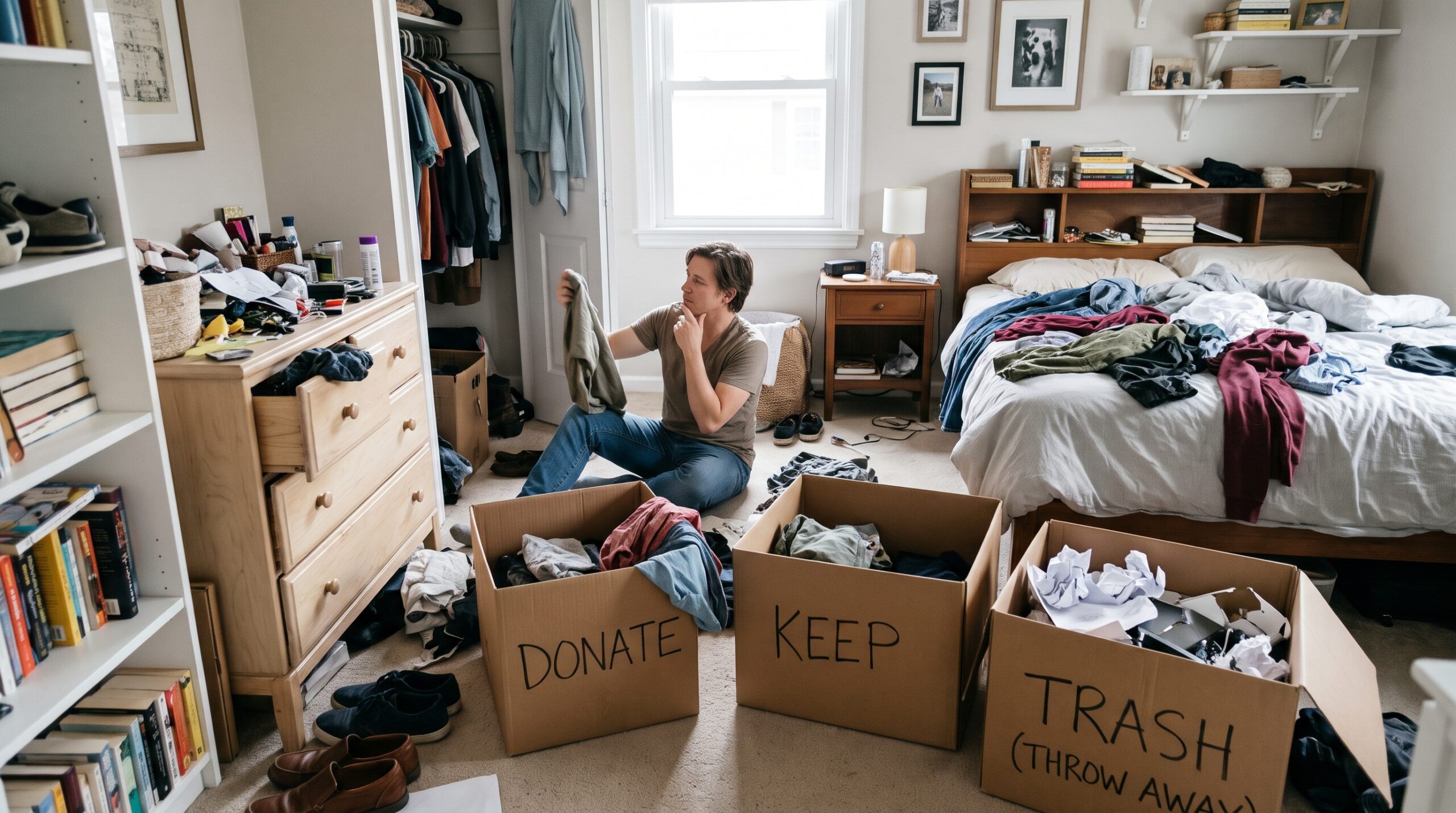
The first thing most people say to me when I walk through their front door is an apology. They apologize for the shoes, for the mail on the counter, and for the guest room they’ve stopped opening. Then, almost every time, they ask me some version of the same question: how to declutter your home when you don’t even know where to begin. However, I tell every one of them the same thing. I have been in hundreds of homes, and I have never once walked in and thought less of the person who lives there. In fact, clutter is not a character flaw. Instead, it’s what happens when life moves faster than your systems do.
After years of working as a professional home organizer, I can tell you that learning how to declutter your home has very little to do with willpower and almost everything to do with order. I don’t mean the order of your shelves, but rather the order in which you tackle things. For example, people who try to fix the whole house in one weekend almost always burn out by Sunday afternoon, usually while standing in a hallway full of half sorted bags. On the other hand, people who go one room at a time, in the right sequence, actually finish. Even better, they stay finished.
That is why I want to share the exact approach I use with clients. It includes the same room order, the same questions, and the same small rules that make the difference between a home that looks good for a week and one that stays calm for years.
Why It Pays to Declutter Your Home
Before we touch a single drawer, it helps to understand why a messy room drains you even when you’re not actively thinking about it. In fact, understanding this is the first real step in learning how to declutter your home for good.
What the Research Shows
Researchers at UCLA’s Center on Everyday Lives of Families spent years filming and documenting the homes of 32 dual income families in Los Angeles. One finding, in particular, has stuck with me ever since I first read it. Women who described their homes using words like “cluttered” and “unfinished” showed daily cortisol patterns associated with chronic stress, and their moods also declined as the day went on. In contrast, people who described their homes as restful showed the opposite pattern. Additionally, the same research team found that only a quarter of the families could park a car in their garage because the space was packed with stuff.
How Clutter Affects Your Focus
There’s also a brain science piece to consider. Princeton psychology professor Sabine Kastner has spent around twenty years studying attention, and her work suggests that visual clutter competes with the brain’s ability to focus and wears out our cognitive functions over time. Furthermore, her lab’s research, published in the Journal of Neuroscience, showed that multiple objects in your field of vision compete with one another for neural processing. In other words, every pile on your counter is quietly asking for a piece of your attention, much like the constant pings that make a digital detox feel so refreshing.
Of course, I share this with clients not to scare them, but to relieve them. If you feel tired every time you walk into your kitchen, you’re not lazy. Rather, your brain is working overtime. As a result, clearing even one surface gives you something real back.
How to Declutter Your Home: The Setup That Saves Hours
Most people skip preparation and jump straight into pulling things out of cabinets. Unfortunately, that’s how a two hour job turns into a two week disaster zone. So here’s what I set up before every session.
Four Containers, Clearly Labeled
First, set out bins for Keep, Donate, Trash, and Relocate. The Relocate basket is the one most guides leave out, yet it’s the most important. It holds things that belong in your home, just not in this room. Without it, you’ll find yourself walking a stray phone charger to the office, then noticing the office desk, and then sorting the office desk. Before long, you’ve abandoned the room you started in. For this reason, the basket stays in the room until the session is over. After that, you empty it in one trip.
A Timer
Next, I work with clients in blocks of 45 to 90 minutes depending on their energy. Decision making is tiring, and after a while people start keeping everything just to stop thinking. So when you notice yourself saying “I’ll just keep it” over and over, that’s not a decision. Instead, that’s fatigue, and it means you should stop for the day.
A Donation Plan With a Date on It
Before you begin, also decide where your donations are going and when they’re leaving. I tell clients donation bags should be out of the house within 48 hours, because bags that sit in the trunk or by the back door have a strange way of getting unpacked again.
One Clear Question
Finally, instead of asking “Do I love this?” or “Could I use this someday?” I ask clients one thing: “If this disappeared tonight, would I buy it again tomorrow?” Because it cuts through guilt quickly, it works on almost anything. In fact, most people find that about a third of what they own fails this test without much argument.
How to Declutter Your Home in the Right Room Order
Here is the sequence I follow, along with the reasoning behind it. Honestly, this order is the backbone of how to declutter your home without burning out halfway through. You start where decisions are easy and the payoff is visible every day, and then you work toward the rooms that carry the most emotional weight. Consequently, by the time you reach the hard stuff, your decision making muscles are stronger and you’ve already seen proof that this works.
1. The Entryway: Where to Begin When You Declutter Your Home
I always start at the front door because it’s small, it’s used every single day, and it sets the tone for the whole house. Similarly, Stephanie Deininger, a home organizer quoted by Homes & Gardens, points to the entryway as one of the most likely trouble spots, since it’s where we come and go and drop things on the way. So if you’re still unsure how to declutter your home, the front door is the easiest place to practice.
To begin, pull everything out of the entry closet and off the hooks. Then count the coats and the shoes. In most homes I visit, the entry holds footwear for every season at once, as well as bags, umbrellas, and sports gear nobody has touched since spring. Therefore, keep only what’s in active rotation for the current season by the door. Everything else gets stored elsewhere or released.
After that, build a landing strip. Use one tray or bowl for keys, one spot for outgoing items like library books and returns, and one small vertical file for incoming mail. Above all, mail is the single biggest driver of entryway clutter I see. However, if it has a home the moment it walks through the door, it stops spreading to the kitchen counter.
Time estimate: one to two hours.
2. The Bathroom
Bathrooms are my second stop because the decisions are almost entirely practical. After all, there’s very little sentiment attached to a half used bottle of shampoo.
First, empty every drawer and the cabinet under the sink. Then check expiration dates on sunscreen, makeup, and medicines, since you’ll be amazed at how much is past its prime. For medications, however, don’t just toss them in the bin. The U.S. Food and Drug Administration recommends using a drug take back program as the best way to get rid of most unused or expired medicines, and many pharmacies also offer drop boxes or mail back envelopes. Meanwhile, only flush medicines that appear on the FDA’s flush list.
Likewise, Jamie Hord, founder of Horderly, makes a point I repeat constantly: declutter first, organize second. In other words, don’t buy a single drawer divider until you know exactly what’s staying. For instance, I’ve seen clients spend hundreds of dollars on acrylic bins for products they ended up throwing away.
Once you’re down to what you actually use, group items by routine. For example, keep morning things together, evening things together, and guest supplies in one basket. In addition, unopened toiletries you no longer want can often go to shelters, which tend to appreciate them.
Time estimate: one to two hours per bathroom.
3. The Kitchen, the Busiest Room to Declutter in Your Home
The kitchen is where your decluttering really starts to show results. At the same time, it’s also where people get stuck on “but I might need it.”
Professional organizer Ben Soreff of House to Home Organizing puts it well when he says that most people know how to clean their dishes but not how to organize them. In short, cleaning and organizing are not the same job.
For this reason, work in zones rather than trying to tackle the whole kitchen at once. Surprisingly, many guides on how to declutter your home skip this step entirely. I usually break it into five zones: food storage (pantry and fridge), cooking tools, dishes and glassware, small appliances, and finally the dreaded junk drawer.
Kitchen Rules I Give Every Client
Count your mugs and travel cups. For instance, Anne Blumer, a professional organizer quoted by SpareFoot, suggests a sensible guideline of about two per person. By comparison, most households I visit have closer to ten.
Keep one of each tool. If you own three spatulas, two can openers, and four sets of measuring spoons, then keep your favorite and release the rest.
Judge appliances by the calendar, not by hope. If the bread maker hasn’t come out in a year, then it’s taking up prime real estate for a version of you that isn’t showing up. Still, that’s okay, so let someone else bake with it.
Match every container to its lid. Otherwise, anything without a partner goes in the recycling.
Clear the Counters Last
Lastly, clear the counters. Only things you use daily should live on them. Interestingly, when I clear a client’s counters, they almost always tell me the kitchen feels twice as big, even though nothing structural changed.
Time estimate: one full day, or three to four shorter sessions.
4. The Living Room
Living rooms collect what I call “drift.” That is, items wander in from every other room and never leave. As a result, this is where your Relocate basket will fill up fastest.
Start by clearing every flat surface, such as the coffee table, side tables, shelves, and the top of the TV stand. Then go through media, including old DVDs, game discs, and tangled cords for devices you no longer own. Next, move on to throw pillows and blankets, because people tend to keep adding these without ever removing any.
Books, on the other hand, are tricky for some clients, so I offer a gentle middle ground. Keep the ones you’ve read and loved, as well as the ones you genuinely plan to read this year. Meanwhile, books you feel you “should” read but haven’t opened in five years are usually ready to go.
Finally, give every category a home. For example, remote controls go in one spot, chargers in another, and blankets in a single basket. When everything has an address, putting things away takes seconds rather than effort.
Time estimate: two to four hours.
5. The Bedroom and Closet: Declutter the Calmest Room in Your Home
Now we start getting into personal territory. Ideally, the bedroom should be the calmest room in the house, yet it’s often where we stash whatever we didn’t have time to deal with elsewhere. Remember the UCLA team’s finding that master bedrooms were the most commonly renovated space but rarely used? Sadly, I see that constantly, with beautiful rooms turned into storage units.
So clear the nightstands first, then under the bed, and then the closet.
Sorting Your Clothes
For clothing, I pull everything out and sort by category, not location. In other words, all jeans go together and all sweaters go together. Seeing seven nearly identical black sweaters in one pile changes the conversation in a way that seeing them scattered across three drawers never does.
Then ask three questions about each piece:
- Does it fit my body right now?
- Have I worn it in the past year?
- Does it suit the life I actually live?
That last one matters most. For example, I’ve worked with retired clients holding onto entire wardrobes of office suits, and likewise with remote workers who still own a closet full of commuter shoes. Indeed, honoring who you are now, not who you used to be, is one of the most freeing parts of figuring out how to declutter your home.
The Hanger Trick
In addition, the hanger trick works well for anyone who isn’t sure. Turn all hangers backward, and then when you wear something, turn its hanger the right way. Consequently, after six months you’ll have clear evidence of what you actually reach for.
Time estimate: half a day for the bedroom, a full day for a large closet.
6. Kids’ Rooms and Play Areas
If you have children, include them in age appropriate ways. For instance, young kids can help decide which stuffed animals stay, while older kids can handle their own closets with some guidance.
I also use the rotation method for toys. Keep about a third of toys out, store the rest in labeled bins, and then swap them every few weeks. Because kids play more creatively with fewer choices, the “new” toys feel exciting again when they come back out. Meanwhile, broken toys, puzzles missing pieces, and anything outgrown can be released.
Artwork, however, is the emotional landmine here. Therefore, I suggest picking a few favorites per school year to keep in a flat archive box and photographing the rest. That way, you’ll keep the memory without drowning in construction paper.
Time estimate: two to four hours per room.
7. The Home Office and Paper
Paper is its own beast. Not only does it multiply quietly, but most people also put off dealing with it because every sheet feels like it might be important.
To handle it, sort into four groups: Action (bills to pay, forms to sign), Reference (documents you must keep), Archive (things you keep for legal or tax reasons but rarely need), and Shred. Shredding anything with account numbers or personal details also helps you protect your privacy. Of course, check with your accountant on how long to hold tax records in your situation. Besides, many statements and manuals can be found online now, so the paper versions can go.
Then stop the inflow. For example, opt out of catalogs, switch to paperless billing, and handle mail at the landing strip you built in the entryway. Otherwise, clearing paper is pointless if a new pile shows up next week.
Time estimate: one to two days, depending on the backlog.
8. The Garage, Basement, and Attic
Storage spaces come near the end on purpose. After all, they’re physically demanding, often full of other people’s things, and packed with items you’ve already decided you don’t need daily. Fortunately, by this stage you’ll have built the confidence to make fast calls.
First, pick a dry day and pull everything into the driveway if you can. Seeing it all in daylight is often the wake up call people need. Next, group similar items, such as tools, holiday décor, sports gear, camping supplies, and paint and chemicals. In addition, dispose of old paint, chemicals, and electronics through your local hazardous waste or recycling programs rather than the regular trash.
After that, only put back what you’ll use in the next year or what has real long term value. Also, use clear, labeled bins and shelving to get things off the floor. Ultimately, if you can park your car in the garage when you’re done, you’ve beaten the odds most families face.
Time estimate: one to three full days.
9. Save Sentimental Items for the End of Your Home Declutter
I always save sentimental things for the very end, no matter which room they live in. This includes letters, photographs, inherited furniture, wedding keepsakes, and a parent’s belongings. If you start here, you’ll stall. However, if you finish here, you’ll arrive with clearer judgment. Truthfully, this emotional side is the part of how to declutter your home that nobody warns you about.
Here are a few things I’ve learned from sitting on floors with clients as they work through memory boxes.
First, the memory is not the object. In fact, keeping one meaningful piece from a set honors it more than keeping a dozen in a damp basement.
Second, photographs help. Take a picture of the item, write a sentence about why it mattered, and then keep that in a digital album or a small printed book. Just be sure to back up your phone so those photos are safe.
Finally, give yourself permission to go slowly, since there’s no deadline on grief or nostalgia. For example, some clients do one box per month, and that’s perfectly fine.
How to Keep Your Home Clear After You Declutter
Getting the house clear is the satisfying part. Keeping it that way, however, is the part most people never get taught. In other words, knowing how to declutter your home is only half the job. So these are the habits I leave with every client.
Daily and Weekly Habits
One in, one out. Whenever something new comes home, something similar leaves. For instance, a new pair of shoes means an old pair goes to the donation bag.
The ten minute reset. Every evening, set a timer for ten minutes and return items to their homes. In fact, families who do this together tell me it’s the single habit that made the biggest difference, and waking up to a clear space makes any morning routine easier.
A permanent donation bin. Also, keep one bag or box somewhere convenient, like the laundry room or a closet floor. When you notice something you don’t want, it goes straight in. Then, when it’s full, it leaves.
Long Term Habits
Seasonal check ins. Twice a year, walk through each room with fresh eyes. Because the foundation is already there, it takes a fraction of the time of the original clearing.
Pause before purchasing. Finally, wait 48 hours before buying non essential items. More often than not, the urge passes, which also makes it easier to save money every month.
When to Hire Help to Declutter Your Home
Sometimes the honest answer is that you need help, and there’s no shame in that. For example, if you’ve tried more than once and keep getting stuck, if the volume feels physically unsafe, or if you’re handling a move, a downsizing, or an estate, a trained organizer can save you weeks.
In that case, look for someone affiliated with the National Association of Productivity and Organizing Professionals (NAPO), which provides education and standards for the industry. Above all, a good organizer won’t judge you or force decisions. Instead, someone who truly understands how to declutter your home will guide you, keep the process moving, and help build systems that suit how you actually live.
Final Thoughts
If there’s one thing I want you to take away from this guide on how to declutter your home, it’s that you don’t have to do it all at once. Rather, you only have to do the next room. So start at the front door this weekend and clear the landing strip. Then enjoy walking in to a calm space on Monday evening. After that, move to the bathroom.
Every client I’ve worked with who reached the finish line got there the same way: one drawer, one shelf, and one room at a time. Ultimately, your home doesn’t need to look like a magazine spread. Instead, it just needs to support the life you’re living right now. And that, in the end, is completely within your reach.
Frequently Asked Questions
Where should I start if I don’t know how to declutter your home?
Start with a small, high traffic area like the entryway or bathroom. Because decisions are quick and results are visible daily, that early momentum makes larger rooms easier. Similarly, Homes & Gardens’ guide on decluttering a home room by room shares this advice from several organizers.
How long does it take to declutter an entire home?
For an average family home, expect anywhere from a few weekends to two months if you work steadily. For example, one popular approach on how to declutter your home, covered by Modern Minimalism, is to tackle one room or category each week.
Should I declutter every room at the same time?
No. Instead, spreading sessions across different days prevents burnout and keeps your judgment sharp, a point Homes & Gardens also makes in its five step room by room guide.
Does clutter really affect stress levels?
Research suggests it can. In fact, studies from UCLA’s Center on Everyday Lives of Families linked cluttered homes with stress hormone patterns, as covered in this Stacker report on disorganized homes and stress.
How should I get rid of old medications found while decluttering?
Use a drug take back site or a mail back envelope whenever possible. Additionally, the FDA explains every option in its guide on where and how to dispose of unused medicines.
How do I let go of sentimental items?
Save them for last, keep a few meaningful pieces rather than everything, and also photograph items you release. Of course, moving slowly is perfectly okay with this category.
How much does a professional organizer cost?
Rates vary by location and experience. However, according to Angi, hiring a professional organizer costs roughly $55 to $140 per hour. In addition, you can find credentialed professionals through NAPO.
References
- Dickson, C. How to Declutter a Home Room by Room: 5 Professional Organizer Steps. Homes & Gardens.
- Turner, O. How to Declutter Room by Room: Organizers Explain Their Approach. Livingetc.
- SpareFoot. How to Declutter Your Home: Best Decluttering Tips for Maintaining a Tidy Home. SpareFoot Blog, 2025.
- Stacker. More Than a Mess: Research Finds Disorganized Homes Increase Stress. KEYT, 2026.
- Closet Factory. UCLA Study Finds Stress Caused by Clutter. Closet Factory Blog.
- Blanding, M. Psychology: Your Attention, Please. Princeton Alumni Weekly.
- McMains, S. and Kastner, S. Interactions of Top Down and Bottom Up Mechanisms in Human Visual Cortex. Journal of Neuroscience, 2011.
- U.S. Food and Drug Administration. Where and How to Dispose of Unused Medicines. FDA Consumer Updates.
- Penner, E. How to Declutter Your Home: A Complete Room by Room Guide. Modern Minimalism, 2025.
- Angi. Decluttering Checklist: How to Organize Every Room in Your Home. Angi.
- National Association of Productivity and Organizing Professionals. NAPO Official Website.