

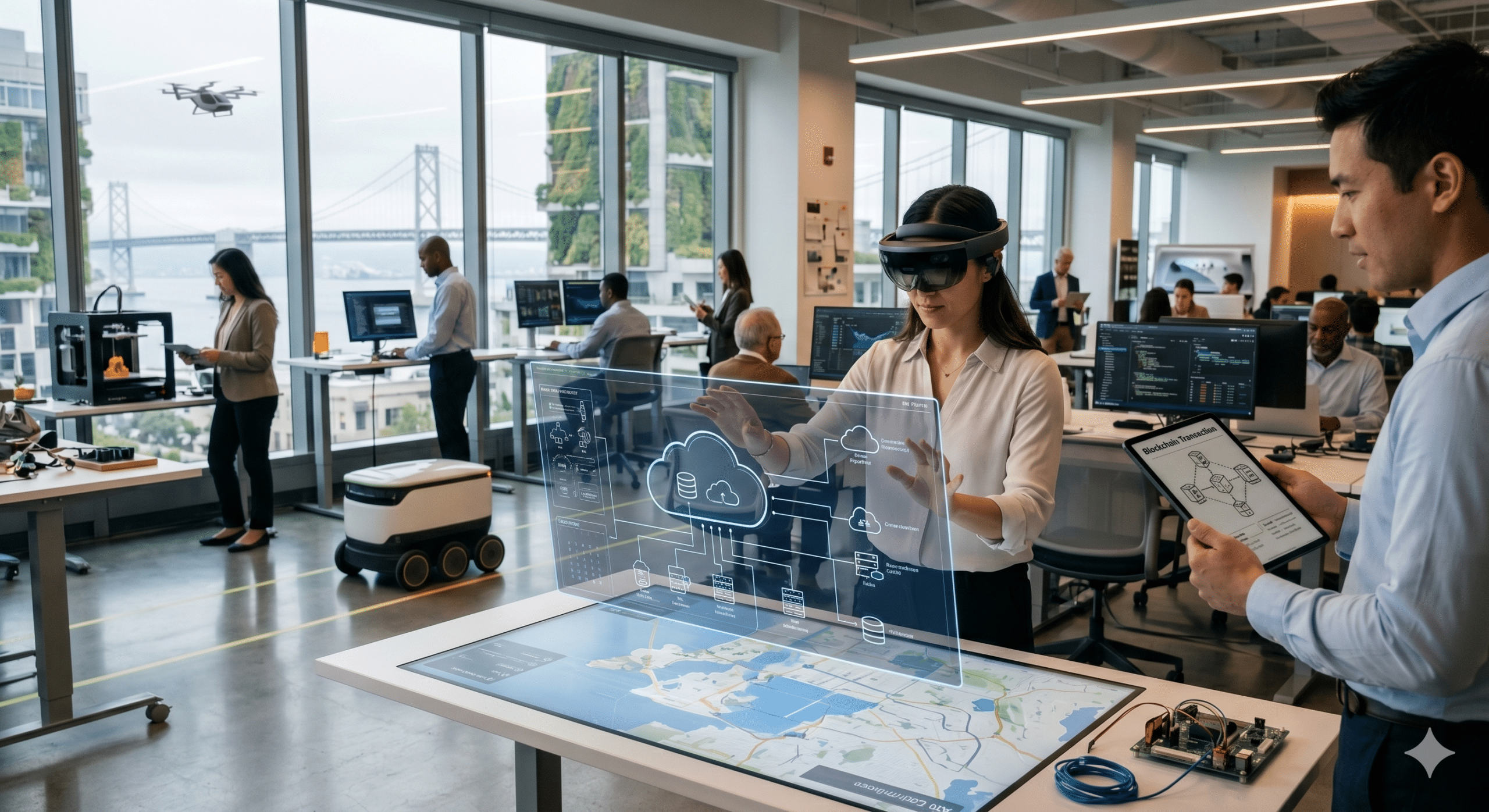
Technology moves fast. One minute everyone is talking about mobile apps and cloud storage, and the next minute businesses are building AI agents, running workloads at the edge, and experimenting with decentralized systems powered by blockchain. As someone who has spent years working in IT infrastructure, cloud environments, and blockchain-related systems, I’ve noticed one thing clearly: the companies that stay curious and adaptable are usually the ones that survive the biggest shifts.
The exciting part about today’s technology landscape is that we are no longer talking about “future concepts.” Many of these innovations are already reshaping businesses, healthcare, finance, logistics, cybersecurity, and even daily life.
In this article, we’ll explore the most important emerging tech trends shaping the future, why they matter, and how they are changing the way organizations operate. Whether you are a business owner, IT professional, student, entrepreneur, or simply someone curious about technology, understanding these trends can help you stay ahead of the curve.
Recent industry reports from organizations like Gartner, Deloitte, and McKinsey & Company continue to highlight AI-driven systems, hybrid cloud infrastructure, cybersecurity, and intelligent automation as major forces shaping the next generation of digital transformation. (Capgemini)
Why Emerging Technology Matters More Than Ever
A decade ago, technology was often treated as a support function. Today, technology is the business.
Retail companies operate like software companies. Banks are becoming digital platforms. Manufacturers rely on automation and predictive analytics. Hospitals use AI-assisted diagnostics. Even agriculture is becoming data-driven through IoT sensors and cloud analytics.
The pressure to innovate has become enormous. Customers expect faster services, personalized experiences, and stronger security. At the same time, businesses must manage rising costs, cyber threats, and global competition.
This is where emerging technologies step in.
The combination of artificial intelligence, cloud computing, blockchain, edge computing, automation, and cybersecurity is creating a new digital ecosystem that is smarter, faster, and more connected than ever before.
Artificial Intelligence Is Becoming the Core of Modern Business
No discussion about emerging technology trends is complete without talking about AI.
Artificial intelligence has moved far beyond chatbots and basic automation. Businesses are now using AI for:
- Predictive analytics
- Customer support automation
- Fraud detection
- Supply chain forecasting
- Medical imaging
- Software development
- Cybersecurity monitoring
- Personalized recommendations
One of the biggest shifts happening right now is the rise of AI-powered business operations. Instead of simply assisting workers, AI systems are beginning to make recommendations, automate decisions, and optimize workflows in real time.
According to recent technology trend reports, AI is becoming deeply integrated into enterprise infrastructure and cloud platforms. (Capgemini)
From my experience working with cloud environments, the real game changer is not just AI itself — it’s the accessibility of AI. Small businesses can now access powerful machine learning tools through cloud providers without building massive infrastructure from scratch.
This lowers the barrier to innovation dramatically.
The Rise of AI Agents and Autonomous Systems
One of the newest developments in artificial intelligence is the rise of AI agents.
These systems can perform tasks with minimal human intervention. Instead of simply responding to commands, AI agents can:
- Analyze information
- Make decisions
- Execute workflows
- Coordinate with other systems
- Learn from outcomes
Major technology trend reports identify multi-agent systems as one of the biggest emerging areas in enterprise computing. (Gartner)
Imagine an e-commerce business where one AI agent handles customer service, another manages inventory forecasting, and another automatically adjusts advertising campaigns based on customer behavior.
We are entering an era where businesses may operate with smaller teams but significantly higher efficiency.
That does not necessarily mean people will disappear from the workforce. Instead, many roles will evolve into supervision, strategy, creativity, and decision-making positions.
Cloud Computing Is Evolving Beyond Storage
Cloud computing used to be mainly about storing files and hosting applications online. Today, it has become the backbone of digital transformation.
Modern cloud environments now power:
- AI workloads
- Big data analytics
- Remote work platforms
- SaaS applications
- DevOps pipelines
- Video streaming
- Blockchain nodes
- Disaster recovery systems
But the cloud itself is changing.
Many organizations are moving toward hybrid and multi-cloud strategies instead of relying on a single provider. According to Deloitte’s recent technology outlook, businesses are balancing cloud flexibility with edge infrastructure and on-premise systems. (Deloitte)
This shift is happening because businesses want:
- Better performance
- Lower latency
- More control over sensitive data
- Improved compliance
- Reduced downtime risk
In practical terms, companies are no longer asking, “Should we move to the cloud?”
Now they are asking, “What is the smartest cloud strategy for our business?”
Edge Computing Is Quietly Transforming Industries
One of the most underrated emerging tech trends is edge computing.
Traditional cloud computing sends data to centralized servers for processing. Edge computing moves processing closer to where the data is created.
This matters because modern applications require speed.
Think about:
- Autonomous vehicles
- Smart factories
- Healthcare monitoring devices
- Smart cities
- Retail analytics
- Industrial automation
These systems cannot always wait for data to travel to distant data centers and back.
Edge computing reduces latency and improves real-time decision-making. Research and industry analysis continue to show edge computing becoming essential for IoT and AI-powered applications. (Medium)
From an engineering perspective, edge computing solves one of the biggest limitations of centralized infrastructure: speed.
As 5G networks expand globally, edge computing adoption will likely accelerate even faster.
Blockchain Is Moving Beyond Cryptocurrency
Many people still associate blockchain only with Bitcoin and cryptocurrencies. But blockchain technology has evolved far beyond digital coins.
At its core, blockchain is about trust, transparency, and decentralization.
Businesses are exploring blockchain for:
- Supply chain tracking
- Digital identity management
- Smart contracts
- Healthcare records
- Cross-border payments
- Asset tokenization
- Intellectual property protection
One area I personally find exciting is blockchain integration with cloud computing and IoT systems. Modern blockchain platforms are becoming more scalable and practical for enterprise environments.
Research continues to highlight the growing connection between blockchain, AI, and cloud infrastructure. (arXiv)
For example, in logistics, blockchain can provide transparent shipment tracking while cloud platforms process analytics and AI systems predict delivery disruptions.
The combination creates stronger visibility and accountability across operations.
Cybersecurity Is Becoming More Intelligent
As technology becomes more advanced, cyber threats are becoming more sophisticated too.
Ransomware attacks, phishing campaigns, AI-generated scams, and data breaches continue to rise globally. This is pushing cybersecurity into the spotlight.
One of the biggest trends right now is AI-driven cybersecurity.
Modern security systems can:
- Detect unusual behavior
- Identify threats faster
- Automate incident response
- Predict vulnerabilities
- Monitor network activity in real time
Gartner’s latest technology trends also highlight preemptive cybersecurity and AI security platforms as critical priorities for organizations. (Gartner)
The reality is simple: traditional security methods are no longer enough.
Organizations now need proactive security models rather than reactive ones.
Zero Trust Architecture is also becoming more common. Instead of assuming users or devices are trustworthy, systems continuously verify access requests.
This mindset shift is reshaping enterprise security strategies worldwide.
Quantum Computing Is Closer Than Many Realize
Quantum computing still sounds futuristic to many people, but progress is accelerating.
Unlike traditional computers that process data in binary bits, quantum systems use qubits, allowing them to solve extremely complex calculations much faster.
Potential applications include:
- Drug discovery
- Financial modeling
- Climate simulations
- Cryptography
- Advanced AI optimization
- Logistics optimization
Industry experts increasingly believe the next major leap in quantum technology may come from software and practical applications rather than hardware alone. (TechRadar)
While quantum computing is not yet mainstream, businesses should start paying attention now because the long-term impact could be enormous.
Especially in cybersecurity.
Quantum computing has the potential to break some traditional encryption systems, which is why researchers are already developing quantum-resistant security models.
The Internet of Things Continues to Expand
The Internet of Things, commonly known as IoT, continues to grow rapidly.
Connected devices are now everywhere:
- Smart thermostats
- Industrial sensors
- Wearables
- Connected vehicles
- Smart appliances
- Healthcare monitors
These devices generate massive amounts of data, which businesses can use to improve efficiency and customer experiences.
The challenge is managing all that data securely and efficiently.
That is why IoT is increasingly connected with:
- Edge computing
- Cloud platforms
- AI analytics
- Blockchain verification systems
The future of IoT is not just about smart devices. It is about intelligent ecosystems that communicate, analyze, and automate processes seamlessly.
Sustainable Technology Is Becoming a Major Priority
One trend that deserves more attention is sustainable technology.
Data centers, AI systems, and cloud infrastructure consume enormous amounts of energy. As demand for AI computing grows, technology companies are racing to build more efficient infrastructure.
Recent reports show major investments in AI-focused data center innovation and energy-efficient architectures. (Reuters)
Businesses are now prioritizing:
- Green data centers
- Renewable energy
- Efficient cooling systems
- Carbon reduction initiatives
- Sustainable cloud operations
This is not just about environmental responsibility. It is also about long-term operational efficiency and cost management.
Sustainability is becoming both a business strategy and a competitive advantage.
The Future of Work Is Being Redefined
Emerging technology trends are also reshaping the workforce itself.
Remote work, digital collaboration tools, AI assistants, and cloud-based operations have permanently changed workplace expectations.
Technology professionals now need skills that combine technical knowledge with adaptability.
Some of the most valuable skills today include:
- Cloud architecture
- AI integration
- Cybersecurity
- Data analytics
- Blockchain development
- DevOps
- Automation engineering
But soft skills matter too.
Communication, creativity, leadership, and strategic thinking are becoming even more important as automation handles repetitive tasks.
The future workforce will likely focus more on innovation and human-centered problem solving.
Industries Being Disrupted the Fastest
Some industries are adopting emerging technologies much faster than others.
Healthcare
AI diagnostics, wearable health devices, blockchain medical records, and telemedicine platforms are transforming healthcare delivery.
Finance
Fintech platforms, decentralized finance, AI fraud detection, and digital banking continue to reshape the financial sector.
Manufacturing
Smart factories powered by IoT sensors, predictive maintenance, robotics, and edge computing are improving production efficiency.
Retail
Personalized shopping experiences, AI recommendations, automated inventory systems, and cashier-less stores are becoming more common.
Logistics
Real-time tracking, autonomous delivery systems, predictive analytics, and blockchain-based supply chains are modernizing logistics operations.
The Human Side of Technology Still Matters
With all the excitement around automation and AI, it is easy to forget something important: technology should serve people.
The most successful technology implementations are not necessarily the most advanced. They are the ones that solve real problems.
As an IT engineer, I’ve seen businesses invest heavily in expensive systems that employees barely use because the human experience was ignored.
Good technology should feel natural, useful, and accessible.
That is why user experience, digital trust, privacy, and ethical AI discussions are becoming increasingly important.
Technology without trust will struggle to succeed long term.
Challenges Businesses Must Prepare For
While emerging technologies create opportunities, they also introduce challenges.
Some of the biggest concerns include:
- Data privacy
- Cybersecurity threats
- AI ethics
- Regulatory compliance
- Vendor lock-in
- Infrastructure costs
- Skills shortages
Businesses that rush into adoption without proper planning may face serious issues later.
The best approach is usually strategic adoption rather than chasing every trend blindly.
Organizations should focus on technologies that align with their goals, customer needs, and operational capabilities.
Final Thoughts on Emerging Tech Trends
We are living through one of the most important technology transitions in modern history.
Artificial intelligence, cloud computing, blockchain, edge computing, cybersecurity, and automation are no longer isolated technologies. They are becoming deeply connected systems that shape how businesses operate and how people interact with the digital world.
What makes this era exciting is that innovation is becoming more accessible. Small startups can now use tools that were once available only to massive enterprises. Developers can deploy AI services in minutes. Businesses can scale globally through cloud infrastructure.
At the same time, the speed of change means continuous learning is no longer optional.
The companies and professionals that stay adaptable, curious, and open to experimentation will have the biggest advantage moving forward.
Technology trends will continue evolving, but one thing is certain: the future belongs to organizations that embrace innovation while keeping people at the center of the experience.
Further Reading and Industry References
If you want to explore more about emerging technology trends, these high-authority resources provide valuable insights:
- Gartner Top Strategic Technology Trends 2026 (Gartner)
- Deloitte Tech Trends 2026 (Deloitte)
- McKinsey Global Tech Agenda 2026 (McKinsey & Company)
- Capgemini Top Tech Trends 2026
- McKinsey Technology Trends Outlook (McKinsey & Company)