

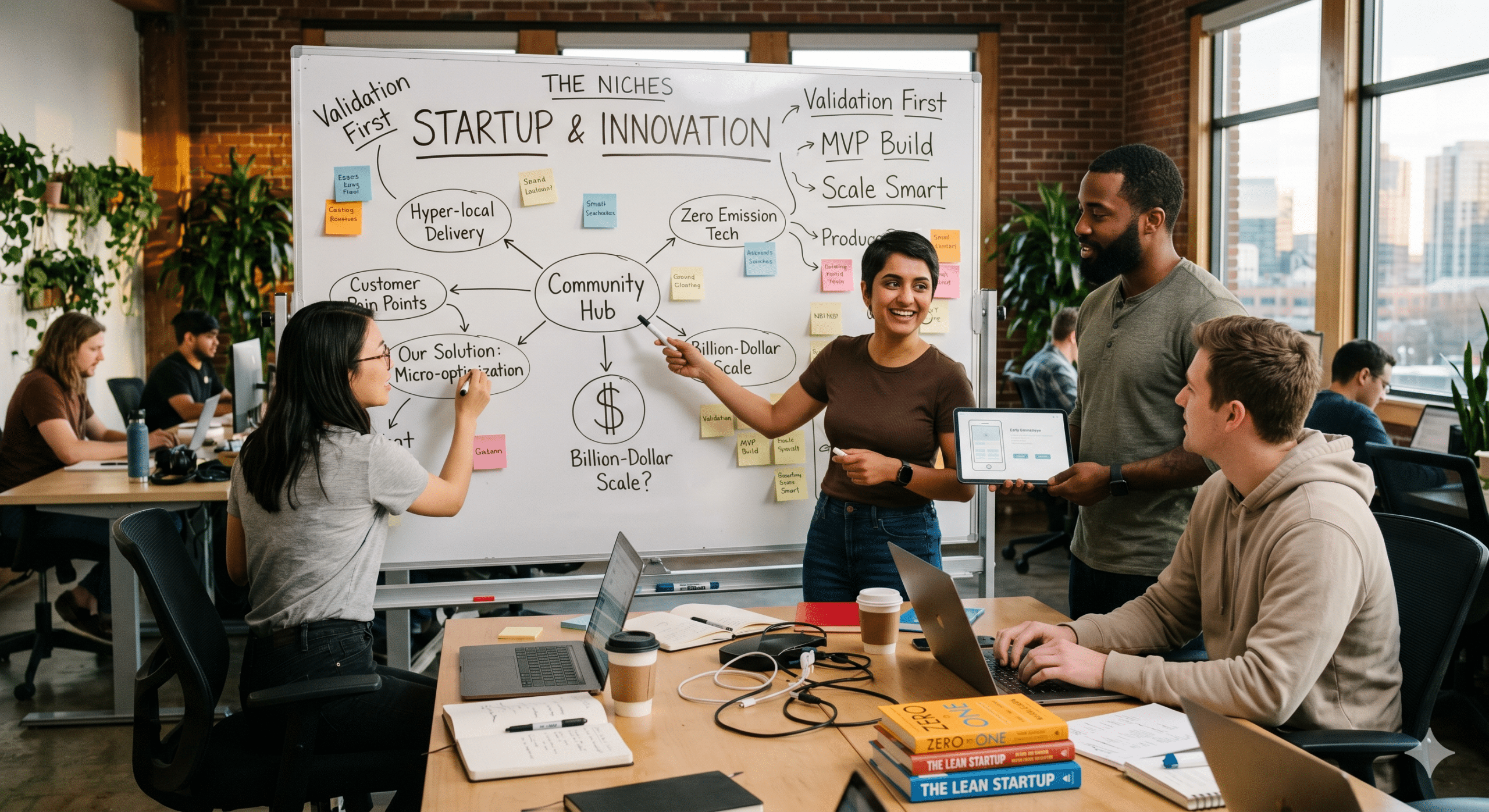
There’s a quiet shift happening in the business world right now.
Not the loud, hype-driven kind filled with buzzwords and flashy investor decks. The real shift is happening behind laptops in coffee shops, inside tiny rented offices, in family homes, and even in late-night brainstorming sessions between friends trying to solve everyday problems.
That’s where modern innovation really begins.
For years, many people believed innovation only belonged to giant tech companies with endless funding and massive engineering teams. Today, that belief is fading fast. Some of the most disruptive businesses in the world started with a simple frustration, a small observation, or one founder asking a basic question:
“What if this could be done better?”
That question has created startups worth millions — and sometimes billions.
As someone who has spent years around IT infrastructure, cloud systems, digital business models, startup investing, and emerging technologies, I’ve noticed one major truth: successful startups rarely begin with perfect ideas. They begin with clarity, timing, adaptability, and the willingness to move before everyone else does.
Innovation is no longer optional. It’s survival.
And in today’s economy, startups are shaping the future faster than traditional corporations can keep up.
According to the OECD, startups continue to play a major role in economic growth, digital transformation, and breakthrough innovation across industries. (OECD)
The New Era of Startup Thinking
A decade ago, many startups focused purely on creating apps.
Today, innovation is happening everywhere:
- Healthcare
- Logistics
- Agriculture
- Education
- Finance
- Real estate
- Hospitality
- Sustainability
- Artificial intelligence
- Cybersecurity
- Creator economy platforms
Modern startups are no longer competing only on products. They compete on speed, user experience, adaptability, and community trust.
That changes everything.
The companies winning today are the ones solving real-world friction.
Sometimes the best startup ideas sound almost too simple:
- Faster payment systems
- Smarter scheduling
- Easier online selling
- AI-powered customer support
- Cloud-based inventory management
- Personalized wellness apps
- Hyperlocal delivery services
- Digital marketplaces for underserved industries
The biggest mistake aspiring founders make is believing innovation must be revolutionary.
Most successful innovation is actually evolutionary.
It improves something people already use.
Why Startups Move Faster Than Big Companies
Large corporations have advantages:
- Bigger budgets
- Established customers
- Massive teams
- Global reach
But startups have one superpower corporations struggle to replicate:
Speed.
A startup can pivot in a week.
A corporation may take six months just to approve a meeting about the pivot.
That speed creates opportunity.
This is why startups continue disrupting industries that once seemed untouchable.
Look at how quickly technology transformed:
- Transportation
- Banking
- Food delivery
- Remote work
- Digital commerce
- Streaming
- Online education
Most disruptions did not begin inside giant boardrooms.
They began with small teams moving quickly.
Research on startup ecosystems consistently highlights adaptability and rapid experimentation as major drivers of innovation success. (Excelerate)
Innovation Is No Longer Just About Technology
One of the biggest misconceptions in entrepreneurship is thinking innovation always means advanced technology.
It doesn’t.
Some startups innovate through:
- Better customer service
- Simpler business models
- Faster delivery systems
- Transparent pricing
- Better branding
- More human communication
- Community-driven experiences
Technology simply accelerates innovation.
But innovation itself starts with understanding people.
That’s why many heavily funded startups still fail.
They focus too much on technology and not enough on solving meaningful problems.
The market doesn’t reward complexity.
It rewards usefulness.
The Rise of AI-Powered Entrepreneurship
Artificial intelligence is changing the startup world faster than most people realize.
Not because AI replaces entrepreneurs.
But because AI lowers the barrier to entry.
Today, a small startup can:
- Build prototypes faster
- Analyze customer behavior
- Automate support
- Create marketing campaigns
- Generate product ideas
- Improve operations
- Reduce staffing costs
- Scale globally with fewer employees
This creates a huge shift in entrepreneurship.
A single founder with AI tools can now accomplish work that once required an entire team.
Recent industry analysis suggests AI is democratizing entrepreneurship by making business creation more accessible to smaller founders and niche markets. (The Washington Post)
That doesn’t mean business becomes easy.
It means execution becomes more important than resources.
The winners will not necessarily be the companies with the most money.
They’ll be the companies with the clearest understanding of customers.
The Startup Mindset That Actually Works
After watching startups grow, pivot, fail, recover, and scale, I’ve noticed something important.
Successful founders think differently.
Not necessarily smarter.
Differently.
They operate with a mindset built around:
- Testing
- Learning
- Adapting
- Improving
- Repeating
Many people wait too long because they want certainty.
Startups rarely offer certainty.
The best founders launch before everything feels perfect.
That’s uncomfortable.
But innovation usually lives inside discomfort.
A startup founder who keeps learning has a much higher chance of surviving than one trying to protect their ego.
In fact, startup research involving dozens of software startups found that customer involvement and rapid MVP experimentation were strongly connected to entrepreneurial success. (arXiv)
Why Most Startups Fail
People often assume startups fail because of competition.
That’s rarely the biggest reason.
Most startups fail because:
- They solve problems nobody cares about
- They burn cash too quickly
- Founders refuse to adapt
- They scale too early
- Poor leadership
- Weak execution
- Lack of market validation
One of the biggest lessons in startup investing is understanding that ideas alone are almost worthless.
Execution creates value.
I’ve seen average ideas become profitable companies because the founders executed brilliantly.
I’ve also seen brilliant ideas collapse because the founders could not adapt to the market.
Innovation without execution is just imagination.
Funding Isn’t the Goal
Many startup founders become obsessed with raising money.
That’s dangerous.
Funding is a tool.
Not a finish line.
Some founders raise millions and still fail.
Others build profitable businesses with almost no outside capital.
The healthiest startups usually focus first on:
- Revenue
- Customers
- Product-market fit
- Sustainability
- Retention
Investors today are becoming smarter and more cautious.
They want:
- Real traction
- Efficient growth
- Scalable systems
- Strong leadership
- Clear market demand
The startup world has matured.
Growth at all costs is no longer enough.
Research on innovation financing shows investors increasingly prioritize sustainable business models, strategic partnerships, and operational resilience. (Six Paths Consulting)
Why Startup Culture Matters
Culture may sound like a soft topic, but in startups, culture affects everything.
A toxic startup culture destroys innovation.
A strong culture accelerates it.
The best startup teams usually share:
- Open communication
- Fast decision-making
- Shared mission
- Accountability
- Adaptability
- Willingness to experiment
One overlooked reality is that innovation grows faster in environments where people feel safe sharing unfinished ideas.
That matters more than most founders realize.
Studies on startup leadership and founder behavior show diverse, collaborative teams consistently outperform rigid organizational structures. (arXiv)
The Most Valuable Startup Skill Today
Many people assume coding is the most valuable startup skill.
It’s important.
But it’s not the most valuable.
The most valuable skill today is problem-solving.
Technology changes constantly.
Markets change constantly.
Consumer behavior changes constantly.
Founders who can identify problems early and adapt quickly become extremely valuable.
That’s why many successful startup founders are not engineers.
They are:
- Operators
- Visionaries
- Marketers
- Product thinkers
- Community builders
- Strategic communicators
The startup ecosystem rewards flexibility more than perfection.
Small Niches Are Creating Massive Businesses
One major shift in entrepreneurship is the rise of niche-focused startups.
Years ago, companies chased broad audiences.
Now many startups dominate by serving very specific communities.
Examples include:
- Pet wellness subscriptions
- AI tools for lawyers
- Farm management platforms
- Creator monetization systems
- Religious merchandise brands
- Senior care marketplaces
- Local tourism apps
- Specialty e-commerce brands
Niche businesses often scale faster because they deeply understand their users.
This creates stronger loyalty.
And loyalty is one of the most underrated assets in modern business.
Innovation Requires Emotional Resilience
Startup culture often glamorizes nonstop hustle.
But experienced founders understand something deeper.
Mental endurance matters more than nonstop motion.
The pressure of entrepreneurship is real:
- Uncertainty
- Financial stress
- Team issues
- Investor pressure
- Competition
- Burnout
Even high-profile startup leaders are now openly discussing mindfulness, emotional clarity, and resilience as competitive advantages. (The Times of India)
The strongest founders are not the loudest.
They are usually the most disciplined emotionally.
Because startups are emotional rollercoasters.
And resilience often determines who survives long enough to succeed.
Why Cloud Technology Changed Everything
From an IT business perspective, cloud computing completely transformed startup economics.
Years ago, launching a tech business required:
- Expensive servers
- Data centers
- Hardware infrastructure
- Large technical teams
Today, cloud platforms allow startups to scale globally with minimal upfront investment.
This dramatically lowered the barrier for innovation.
A startup can now:
- Deploy globally
- Scale on demand
- Automate infrastructure
- Operate remotely
- Integrate AI tools
- Launch faster than ever
Cloud systems gave startups enterprise-level capabilities without enterprise-level costs.
That’s one reason startup growth accelerated so rapidly worldwide.
The Future Belongs to Hybrid Founders
One trend I believe will continue growing is the rise of hybrid founders.
These are entrepreneurs who combine:
- Technology understanding
- Business strategy
- Community building
- Content creation
- Data awareness
- Operational execution
The future founder is no longer just technical.
They are multidimensional.
The strongest startup leaders understand both:
- Human behavior
- Digital systems
That combination becomes incredibly powerful.
Startups Are Reshaping Emerging Markets
Some of the most exciting startup opportunities today are happening outside traditional Silicon Valley ecosystems.
Emerging markets are exploding with innovation because:
- Mobile adoption is growing
- Digital payments are increasing
- Younger populations embrace technology quickly
- Traditional industries remain underserved
Countries across Southeast Asia, Africa, and Latin America are producing remarkable startups solving local challenges.
That creates enormous opportunity for founders who understand regional markets.
Sometimes the next billion-dollar business is not inventing something new.
It’s adapting successful models for underserved populations.
The Biggest Opportunity Most People Ignore
Many aspiring entrepreneurs spend too much time searching for “perfect startup ideas.”
But opportunities usually appear through exposure.
The more industries you study:
- The more inefficiencies you notice
- The more customer frustrations you observe
- The more business gaps become visible
That’s why curiosity matters in entrepreneurship.
Innovation often begins by paying attention.
Some of the best startup ideas come from:
- Personal frustrations
- Industry experience
- Repetitive inefficiencies
- Customer complaints
- Poor user experiences
Founders who stay close to real-world problems usually build more sustainable businesses.
The Future of Innovation
The next decade will likely produce even faster startup growth because several forces are colliding at once:
- Artificial intelligence
- Automation
- Cloud computing
- Remote work
- Digital commerce
- Creator-driven economies
- Global online collaboration
But despite all the technology, one thing remains unchanged.
People still want businesses that:
- Save time
- Reduce stress
- Improve convenience
- Build trust
- Create emotional connection
Technology evolves.
Human behavior evolves slower.
That’s why the best startups combine innovation with humanity.
Final Thoughts
Startup innovation is not reserved for genius inventors or billionaire-backed founders.
It belongs to people willing to:
- Observe problems
- Move quickly
- Learn constantly
- Adapt relentlessly
- Stay resilient through uncertainty
The future economy will increasingly reward creators, builders, and problem-solvers.
Not because entrepreneurship is trendy.
But because innovation has become one of the most important survival skills in modern business.
And perhaps the most exciting part of all?
The next great startup idea may already exist inside an ordinary problem someone experiences every single day.
The difference between an idea and a breakthrough business is usually one thing:
Execution.
Further Reading
For deeper insights on startup innovation, entrepreneurship trends, and business transformation, these high-authority resources are worth exploring:
- OECD Startup Innovation Insights
- Harvard Business School Online – Innovation in Business
- IMD Business Innovation Guide
- VentureWell Entrepreneurship Trends
- Plug and Play Tech Center Innovation Strategy