

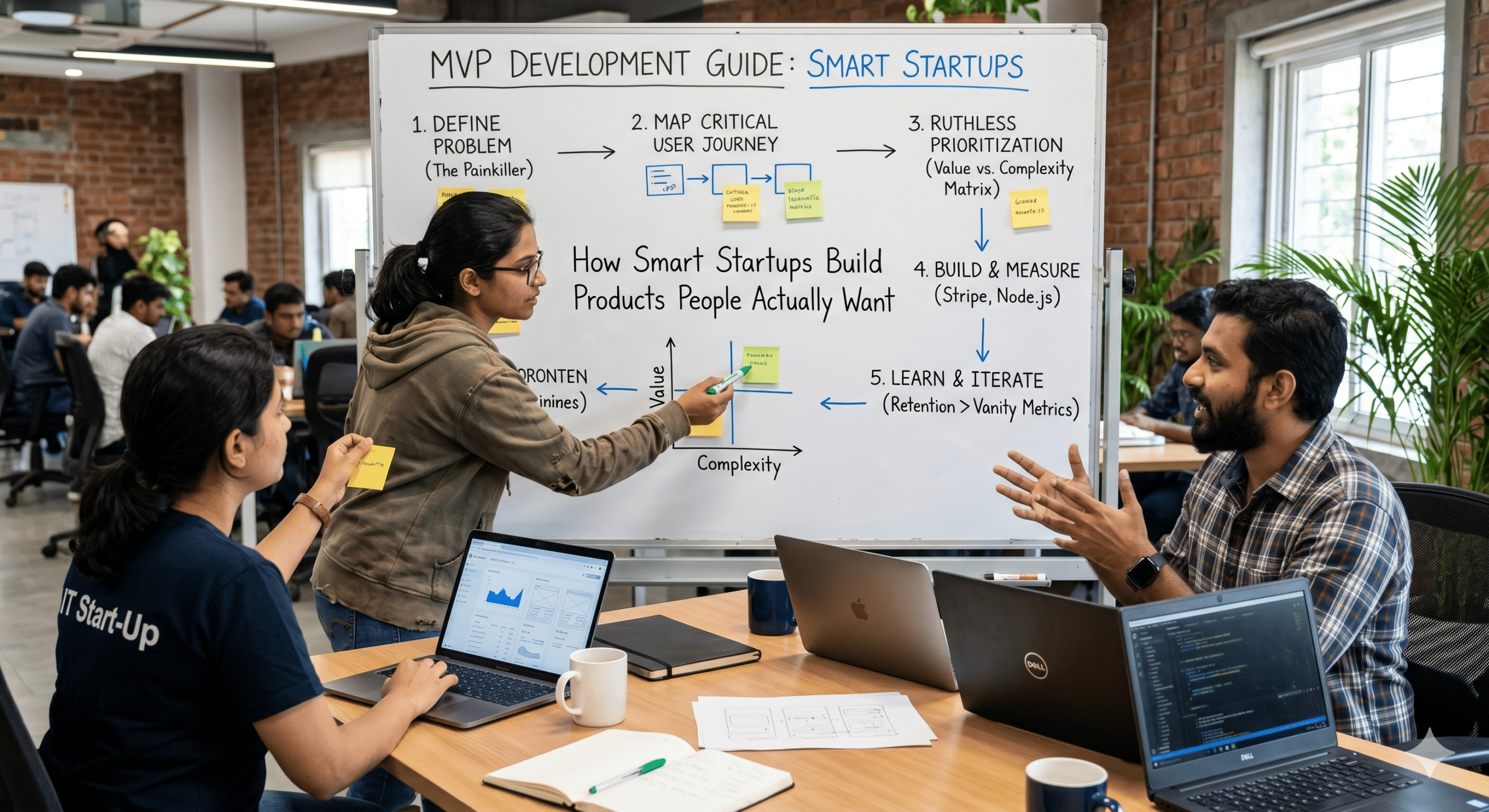
This MVP Development Guide is designed to help startups, entrepreneurs, and tech founders build products smarter, faster, and with less risk. In today’s competitive startup landscape, launching a successful product is no longer about building everything at once. It’s about validating ideas early, understanding customer needs, and creating a lean product that solves a real problem before investing significant time and money.
Every startup founder has that moment.
You’re sitting with an idea that feels big enough to change an industry. You can already imagine the app screens, investor pitch deck, launch announcement, and maybe even the headline about your company getting acquired someday.
Then reality hits.
Building software is expensive. Time disappears fast. Developers cost money. And the biggest fear quietly creeps in:
What if nobody actually wants this product?
That’s exactly why MVP development exists.
What Is an MVP Development Guide and Why Does It Matter?
An MVP, or Minimum Viable Product, is the simplest usable version of a product that solves a real problem for real users.
The keyword here is usable.
A lot of founders misunderstand MVPs. They think an MVP means incomplete, ugly, or rushed. That’s not true.
A good MVP delivers one core value exceptionally well.
Instead of building ten features halfway, smart startups build one critical experience that works properly.
The purpose is simple:
- Test demand
- Validate assumptions
- Learn from users
- Reduce wasted spending
- Improve product-market fit
According to lean startup principles, MVPs help founders achieve “validated learning” faster by getting real customer feedback early. (Wikipedia). A practical MVP Development Guide helps startups avoid wasting time and money on features customers may never use.
That matters because one of the biggest reasons startups fail is building products customers don’t actually need. Multiple startup and MVP studies continue highlighting poor product-market fit as a major cause of failure. (Dash Technologies Inc.)
Why Every MVP Development Guide Focuses on Validation
Startup ecosystems have changed dramatically.
A few years ago, investors often funded ideas aggressively. Today, capital is tighter, competition is faster, and users expect polished experiences immediately.
That means founders need proof.
Investors now look for:
- Early traction
- User engagement
- Retention
- Revenue validation
- Real-world usage data
An MVP helps provide all of that.
Modern MVP development is no longer just about launching quickly. It’s about launching intelligently.
Recent startup development trends show founders increasingly focusing on:
- lean execution
- agile development
- rapid iteration
- scalable architecture
- customer-driven product decisions
- no-code and low-code acceleration tools (GainHQ)
The startups winning today are the ones learning faster than competitors.
The Biggest MVP Mistake Founders Make
Most founders build too much.
They spend months planning features users never requested.
I’ve seen startup teams spend:
- six months building dashboards nobody used
- thousands of dollars designing advanced admin systems before acquiring users
- endless development cycles polishing features before validation
This usually happens because founders confuse vision with execution timing.
Your full vision may eventually require 50 features.
Your MVP probably needs three.
The discipline of MVP development is learning how to separate:
- essential features
from - emotional attachment
That’s difficult for founders because every feature feels important.
But in early-stage startups, focus is everything.
Step 1: Validate the Problem Before Writing Code
Before touching development, validate the problem first.
This single step can save months of wasted effort.
Start by answering:
- What exact problem are you solving?
- Who experiences this problem?
- How painful is it?
- How are people solving it today?
- Why are existing solutions failing?
Talk to real users.
Not friends trying to encourage you.
Not family members being polite.
Talk to potential paying customers.
Some of the best validation methods include:
- customer interviews
- Reddit communities
- niche Facebook groups
- LinkedIn conversations
- industry forums
- surveys
- competitor reviews
Look for repeated frustrations.
When people consistently complain about the same problem, you’re probably onto something valuable.
Strong MVP development starts with customer pain, not founder excitement.
Recent MVP frameworks emphasize market validation and customer research as foundational stages before development even begins. (Dash Technologies Inc.)
Step 2: Define Your Core Value Proposition
Once the problem is validated, define your core promise.
This should be clear in one sentence.
A strong value proposition explains:
- who the product helps
- what problem it solves
- why it’s different
Examples:
- “Helping freelancers invoice clients in under 60 seconds.”
- “Making restaurant inventory management easier for small business owners.”
- “Allowing remote teams to track tasks without complicated software.”
Notice something important:
These statements focus on outcomes, not features.
Users care about results.
They don’t care that your app uses advanced AI architecture or serverless infrastructure.
They care that it saves time, makes money, reduces stress, or solves friction.
Step 3: Prioritize Features Ruthlessly
This is where startup discipline matters.
You need to identify:
- Must-have features
- Nice-to-have features
- Future features
Only build the must-have features.
One of the most common MVP prioritization methods is the MoSCoW framework:
- Must Have
- Should Have
- Could Have
- Won’t Have Yet
Modern MVP development guides consistently emphasize feature prioritization because overbuilding slows validation and increases cost. (Dash Technologies Inc.)
Here’s a simple rule:
If removing a feature still allows the product to solve the main problem, remove it.
Your MVP should feel focused, not overloaded.
Step 4: Choose the Right MVP Type
Not every MVP needs a fully coded application.
This is one of the biggest misconceptions in startup culture.
Depending on your business model, your MVP might be:
Landing Page MVP
A simple website validating interest before development.
Great for:
- SaaS ideas
- marketplaces
- subscription products
Concierge MVP
You manually deliver the service behind the scenes.
This is how many successful startups began.
No-Code MVP
Built using platforms like:
- Bubble
- Webflow
- Glide
- Softr
No-code development is becoming increasingly popular because it reduces cost and accelerates launch timelines. (WeWeb)
Prototype MVP
Interactive mockups used for testing workflows and user behavior.
Single-Feature MVP
One powerful feature solving one major problem.
The best approach depends on:
- budget
- timeline
- technical complexity
- market urgency
- founder skill set
Step 5: Build Fast — But Build Smart
Speed matters in startups.
But speed without structure creates technical debt.
When developing an MVP, focus on:
- scalability basics
- clean architecture
- simple UI
- strong onboarding
- analytics tracking
- fast iteration capability
You don’t need enterprise-level infrastructure immediately.
But you do need flexibility.
Modern startup MVP frameworks increasingly emphasize agile development and iterative product cycles. (Dash Technologies Inc.)
Your first version should be designed for learning.
Not perfection.
Choosing the Right Tech Stack in an MVP Development Guide
Founders often obsess over technology choices too early.
The reality?
Your tech stack matters less than:
- solving a real problem
- launching quickly
- gathering feedback
That said, good startup stacks usually prioritize:
- rapid development
- scalability
- affordable hosting
- developer availability
Popular startup MVP stacks include:
- React
- Next.js
- Node.js
- Firebase
- Supabase
- PostgreSQL
- Flutter
Cloud-based infrastructure is now standard for startup scalability and cost efficiency. (LinkedIn)
If you’re non-technical, consider:
- technical co-founders
- freelance developers
- startup-focused MVP agencies
- no-code solutions
The goal is momentum, not engineering perfection.
UX Matters More Than Founders Think
A common startup mistake is assuming users tolerate poor experiences because it’s “just an MVP.”
They don’t.
Users compare your startup to every polished app they already use daily.
Your MVP doesn’t need every feature.
But it does need:
- clean navigation
- intuitive workflows
- fast loading
- clear messaging
- minimal friction
Even early adopters expect usability.
Good UX increases:
- retention
- onboarding success
- user trust
- investor confidence
How Long Should MVP Development Take?
Most strong MVPs can launch within:
- 4 to 12 weeks
If development stretches endlessly, you’re probably overbuilding.
Several MVP development experts now recommend lean timelines specifically to accelerate feedback loops and market learning. (WeWeb)
Remember:
Your MVP is not the final product.
It’s the beginning of the learning phase.
How Much Does an MVP Cost?
This depends heavily on complexity.
Typical MVP ranges:
- No-code MVP: $1,000–$10,000
- Freelance-built MVP: $5,000–$30,000
- Startup agency MVP: $20,000–$100,000+
Complex products involving:
- AI
- fintech
- healthcare
- marketplaces
- enterprise systems
may cost significantly more.
The smartest founders control scope aggressively.
Your first goal is validation, not scale.
What Metrics Should You Track?
An MVP without analytics is basically guesswork.
Track:
- user acquisition
- activation rate
- retention
- churn
- conversion
- engagement
- customer feedback
- feature usage
One of the most important startup principles is the Build-Measure-Learn loop from lean startup methodology. (WeWeb)
That loop only works if you measure properly.
How to Know If Your MVP Is Working
Many founders assume success means “users signed up.”
Not necessarily.
The real question is:
Do users continue using it?
Strong validation signs include:
- repeat usage
- referrals
- customer feedback
- waitlists
- retention
- willingness to pay
Revenue validation is especially powerful.
Even small payments prove demand more effectively than compliments.
When to Pivot
Not every MVP succeeds immediately.
That’s normal.
Some of the biggest startups pivoted multiple times before finding traction.
A pivot doesn’t mean failure.
It means learning.
You may need to adjust:
- audience
- pricing
- features
- positioning
- user flow
- monetization strategy
Good founders listen to data instead of forcing assumptions.
MVP Development and Startup Funding
Investors rarely fund ideas alone anymore.
They fund evidence.
A solid MVP can dramatically improve fundraising because it demonstrates:
- execution capability
- market validation
- user demand
- traction
- learning velocity
Even modest traction can strengthen your pitch significantly.
Investors want proof that your startup understands:
- the market
- the customer
- the problem
- the growth opportunity
An MVP helps provide that proof.
Common MVP Development Mistakes
Building Too Many Features
The classic startup mistake.
Ignoring Customer Feedback
Users tell you what matters.
Listen carefully.
Delaying Launch
Perfection kills momentum.
Hiring the Wrong Developers
Cheap development often becomes expensive later.
Focusing on Vanity Metrics
Downloads mean nothing without engagement.
Skipping Validation
Never assume demand exists.
The Future of MVP Development
Modern startup ecosystems are moving toward:
- AI-assisted development
- no-code acceleration
- cloud-native architecture
- rapid prototyping
- lean validation
- smaller startup teams
The barrier to launching products has never been lower.
But competition has never been higher either.
That means execution quality matters more than ever.
Founders who move quickly, learn rapidly, and iterate intelligently will continue winning.
Final Thoughts
Ultimately, this MVP Development Guide is about building products strategically instead of emotionally. The startups that succeed are usually the ones that validate quickly, adapt continuously, and stay focused on solving real customer problems.
The best startups rarely begin as massive platforms.
They begin as focused solutions to painful problems.
That’s the real purpose of MVP development.
Not to launch something small.
But to launch something smart.
A great MVP helps you:
- reduce risk
- validate demand
- conserve capital
- learn faster
- improve product-market fit
- attract investors
- build momentum
The founders who succeed are usually not the ones with the biggest initial ideas.
They’re the ones willing to test, adapt, improve, and keep learning faster than everyone else.
That’s the real startup advantage.
Further Reading From High-Authority Sources
- Lean Startup Methodology Overview
- Y Combinator Startup Library
- TechCrunch Startup News and Insights
- Harvard Business Review on Product Validation
- Product Hunt for MVP Launch Inspiration
- First Round Review Startup Growth Articles